
State‑by‑state auto insurance requirements in the United States
Auto insurance in the United States looks simple until you actually need it. Most drivers know they must be insured. Far fewer understand what that requirement really means, how it changes from state to state, or why the same accident can have completely different consequences depending on where it happens.
This article is not here to sell you a policy. It’s not here to oversimplify a legal system that is, by nature, fragmented. It’s here to explain clearly and honestly how auto insurance requirements work across the U.S., why they differ, and what those differences mean in real situations, not theoretical ones.
If you drive in the United States, this matters more than most people realize.
Why auto insurance laws differ by state

There is no single auto insurance law in the United States. That surprises many people, especially those coming from countries with centralized insurance systems.
In the U.S., insurance regulation is handled at the state level. Each state legislature decides what drivers must carry, how claims are handled, and what penalties apply when drivers break the rules.
Why does that matter? Because states don’t all face the same risks.
A rural state with low traffic density does not face the same accident patterns as a densely populated urban state. Healthcare costs vary. Court systems vary. Political priorities vary. Over time, each state built its own version of “acceptable risk.”
That’s why auto insurance law in the U.S. isn’t inconsistent. It’s localized.
How auto insurance works in the U.S.
At a basic level, auto insurance is a financial responsibility system. If you cause harm with your vehicle, someone has to pay. Insurance determines who pays, how fast, and up to what limit.
But “insurance” is not one thing. It’s a combination of coverages, each designed to handle a specific type of loss.
Liability coverage

Liability coverage is the backbone of U.S. auto insurance law.
It covers:
- Injuries you cause to others
- Damage you cause to other people’s property
It does not cover you.
Most states require liability coverage, and most express it using three numbers, for example: 25/50/25.
| Coverage type | What it pays for | Limit |
|---|---|---|
| Bodily injury (per person) | Injury to one person | $25,000 |
| Bodily injury (per accident) | Total injuries | $50,000 |
| Property damage | Other people’s property | $25,000 |
On paper, this looks reasonable.
In practice, it often isn’t.
One modern vehicle can exceed the property damage limit on its own. One hospital visit can exceed the injury limit before the ambulance ride is finished.
PIP and medical coverage

Some states take a different approach. Instead of focusing on who caused the accident, they focus on paying medical bills quickly.
That’s where personal injury protection (PIP) and medical payments (MedPay) come in.
PIP may cover:
- Medical expenses
- Lost income
- Rehabilitation
- Essential services
MedPay is more limited, usually medical bills only.
These coverages are common sometimes mandatory in no‑fault states, where each driver’s insurance handles their own injuries regardless of who caused the crash.
It’s efficient. It’s also misunderstood.
Uninsured and underinsured motorist coverage
Not everyone follows the law. And even insured drivers can be underinsured.
Uninsured/underinsured motorist coverage exists for that exact reason.
It protects you when:
- The at‑fault driver has no insurance
- Their coverage limits are too low
Some states require it. Others allow drivers to reject it. Many do usually to save money.
That decision often looks smart right up until the moment it isn’t.
Minimum legal requirements vs recommended coverage
This is where most confusion starts.
Minimum coverage is not designed to protect you. It is designed to protect the public from completely uninsured drivers.
That distinction matters.
Minimum coverage: the legal threshold
Minimum coverage allows you to:
- Register your vehicle
- Drive legally
- Avoid immediate penalties
That’s it.
Recommended coverage: the practical reality
Recommended coverage reflects:
- Actual medical costs
- Real vehicle values
- Lawsuit risk
- Personal asset exposure
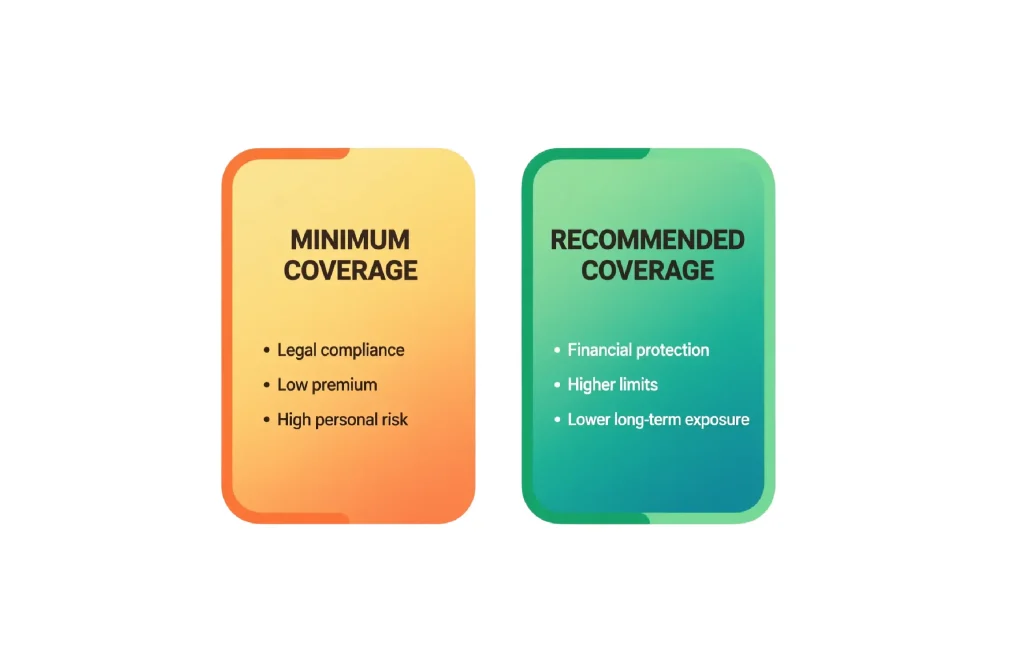
Most people don’t think about this difference until after an accident. That’s usually when the numbers stop feeling abstract.
No‑fault vs at‑fault insurance systems

States generally follow one of two systems.
At‑fault states
In at‑fault states:
- The driver who caused the accident is responsible
- Claims are made against that driver’s insurance
- Lawsuits are common
This system emphasizes accountability, but it can be slow and adversarial.
No‑fault states
In no‑fault states:
- Each driver’s insurance pays their own medical bills
- PIP is mandatory
- Lawsuits are limited to serious injuries
| Aspect | At‑fault | No‑fault |
|---|---|---|
| Medical bills | At‑fault insurer | Your insurer |
| Lawsuits | Common | Restricted |
| Claim speed | Slower | Faster |
Neither system is perfect. Each reflects a trade‑off between efficiency and legal rights.
What happens if you drive without insurance

Driving uninsured is illegal in almost every U.S. state. The penalties are rarely light.
Common consequences include:
- Fines
- License suspension
- Vehicle impoundment
- SR‑22 or FR‑44 requirements
- Long‑term premium increases
If you cause an accident while uninsured, the financial exposure can follow you for years. Sometimes decades.
Courts don’t care why you were uninsured. Only that you were.
Proof of insurance rules across states
Having insurance is not enough. You must be able to prove it.
States may require:
- Physical insurance cards
- Digital proof
- Database verification
Proof may be requested:
- During traffic stops
- After accidents
- When registering or renewing a vehicle
Failing to show proof even if you are insured can still result in penalties. That surprises many drivers.
How to find your state’s exact requirements
Insurance rules change. Limits are updated. Systems evolve.
The only reliable sources are:
- State DMV websites
- Departments of insurance
- Official state statutes
Third‑party summaries are useful, but they are not authoritative. If accuracy matters and it does check the source.
Auto insurance requirements by state
Every state sets its own baseline.
Some require only liability coverage. Others require additional protections such as PIP or uninsured motorist coverage.
| State category | Typical requirements |
|---|---|
| Liability‑only | BI + property damage |
| No‑fault | Liability + PIP |
| Hybrid | Liability + UM/UIM |
This diversity is intentional. It reflects how differently states approach risk, responsibility, and compensation.
Why moving between states changes everything

Moving across state lines resets the rules.
Your old policy may:
- No longer meet minimum requirements
- Be non‑compliant for registration
- Expose you to penalties
Insurance should be updated immediately after relocation. Waiting “until later” creates risk that most drivers don’t realize they’re taking.
Special situations that affect requirements
Some drivers face stricter rules.
High‑risk drivers
- SR‑22 or FR‑44 filings
- Higher minimum limits
Leased or financed vehicles
- Comprehensive and collision required
- Lender rules override state minimums
Commercial or rideshare use
- Personal policies may not apply
- Separate coverage may be required
These situations are common. They’re also commonly misunderstood.
How states enforce insurance laws
Enforcement has become more aggressive over time.
Many states now use:
- Real‑time insurance verification
- Automated registration blocks
- Electronic reporting by insurers
Non‑compliance is harder to hide than it used to be. Technology has changed the game.
Insurance as legal and financial protection
Auto insurance is not just a legal formality. It’s a liability management tool.
Adequate coverage can:
- Protect assets
- Reduce lawsuit exposure
- Prevent financial collapse after an accident
Minimum coverage satisfies the law. It does not guarantee safety.
Common misunderstandings
Many drivers believe:
- “Minimum coverage is enough”
- “Good drivers don’t need high limits”
- “My policy works the same everywhere”
These beliefs are common. They are also often wrong.
How to think about coverage rationally
The real question isn’t:
“What’s the cheapest legal option?”
It’s:
“How much risk am I willing to keep for myself?”
Insurance transfers risk. The less coverage you buy, the more risk you personally carry.

State‑by‑state auto insurance requirements in the United States are complex because the system was designed to be local, not uniform.
Understanding the differences isn’t about memorizing numbers. It’s about understanding how liability works, how quickly costs escalate, and how legal minimums often fall short of real protection.
Drivers who treat insurance as a strategic decision not just a legal obligation are almost always better positioned when something goes wrong.
And eventually, something does.
Frequently asked questions
Is auto insurance mandatory in every state?
Almost all states require it, though a few allow alternatives under strict conditions.
Can I keep my old policy after moving?
Only temporarily. Policies must comply with your new state’s laws.
Is digital proof accepted everywhere?
Not everywhere. Always verify local rules.
Does minimum coverage prevent lawsuits?
No. You can still be personally liable beyond your limits.
Why do no‑fault states require PIP?
To pay medical bills quickly and reduce court involvement.
Stay covered, stay safe, and happy driving.