Complete guide to selling your used car for maximum value (2026)
Private sellers in the US leave an average of $1,500 to $3,000 on the table every time they sell a used car. Not because their vehicle isn’t worth more — but because they treat the transaction as a single event rather than a sequence of decisions that compound on each other.
Pricing a car is one decision. Choosing the right platform is another. How you present the vehicle, how you write the listing, how you handle the first lowball offer, and how you close the paperwork without legal gaps — each of these is a separate lever. Pull all of them correctly and you sell faster, at a higher number, with fewer headaches. Miss one and you feel it directly in your final payout.”Every tactic in this guide is built around one goal: how to get the most money for your used car without spending weeks on the process.”
This guide covers the entire sequence from start to finish. It’s built from real private sale data — platform-by-platform price comparisons, ROI figures on prep work, and negotiation patterns drawn from hundreds of transactions. Whether you’re selling a $9,000 commuter car or a $35,000 truck, the framework is the same. The numbers scale, but the logic doesn’t change.
By the end, you’ll know exactly what your car is worth, where to sell it, how to present it, how to write a listing that attracts the right buyers, how to hold your price when buyers push back, and how to close the deal legally without loose ends.
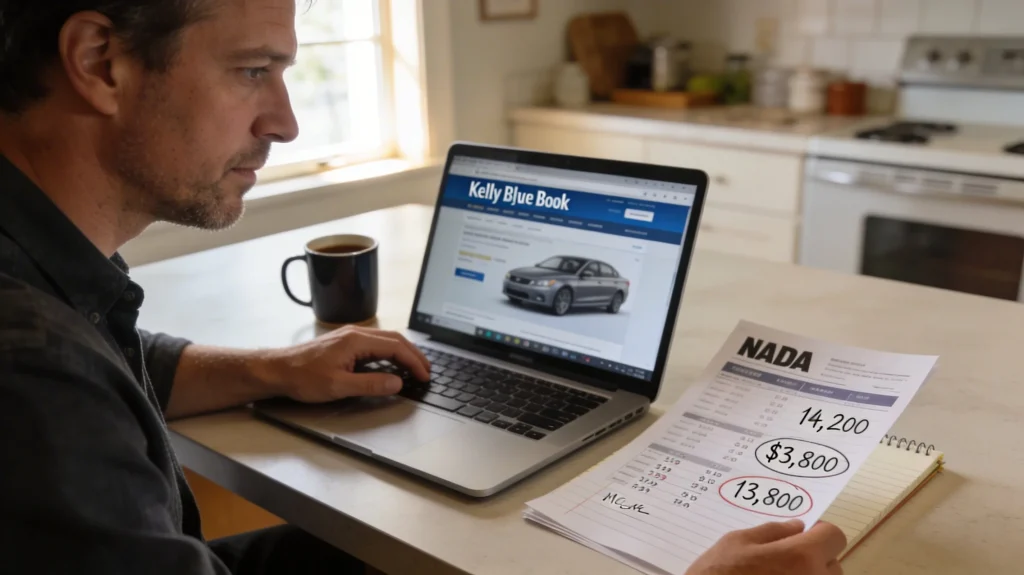
Most sellers approach pricing with a single tool and a feeling. They check Kelley Blue Book, add a few hundred dollars because they believe their car is in better shape than average, and post the listing. Three weeks later the car is still sitting, the price has dropped twice, and they’ve lost both time and negotiating leverage.
Sellers who price within 3 percent of actual market value sell 47 percent faster than those who overprice by 10 percent or more. That statistic doesn’t mean pricing low — it means pricing accurately, with data to back it up.
The three-tool method
Accurate pricing requires three data sources used together, not one used in isolation.
Kelley Blue Book (KBB) is the industry standard for private-party transactions. Input the exact mileage, your zip code, and every factory option the vehicle has. The condition tier you select — Fair, Good, Very Good, or Excellent — has a larger impact on the output than most sellers realize. The difference between Good and Very Good on a $16,000 car is typically $900 to $1,100. Be honest with yourself about where your car genuinely lands.
NADA Guides run 5 to 8 percent higher than KBB because they’re calibrated for dealer-facing scenarios. That doesn’t make them irrelevant for private sellers — it makes NADA useful as a ceiling reference. When a buyer challenges your asking price, being able to reference both KBB and NADA gives you a range rather than a single number, which is a significantly stronger negotiating position.
Local comparable listings are what most sellers skip entirely, and they’re often the most important input. Spend 20 minutes on Facebook Marketplace and Craigslist searching your exact year, make, model, and trim within a 50-mile radius. If eight comparable vehicles are listed between $13,800 and $14,500 and yours is at $15,200 with no visible differentiation, you’re not competitive — you’re just optimistic. Local comps tell you what the market will actually support in your specific geography.
Mileage thresholds aren’t gradual
Depreciation in used vehicles doesn’t move in a straight line. The market prices in psychological thresholds — specific mileage points where perceived risk increases sharply regardless of actual mechanical condition.
The two most impactful thresholds for the majority of vehicles are 75,000 and 100,000 miles. A car at 73,000 miles commands meaningfully more than the identical car at 77,000 — not because of the 4,000 additional miles, but because buyers start mentally discounting for powertrain service intervals once they cross 75K. The same dynamic applies at 100,000 miles, where perception of risk accelerates regardless of actual reliability data.
If your odometer sits within 2,000 miles of one of these thresholds, account for it explicitly in your pricing. It’s not about gaming the system — it’s about understanding how buyers actually evaluate cars.
The $40 investment that closes $380 above asking
A single-vehicle CarFax report costs $39.99. Listings that include one close at an average of $380 above comparable listings without documentation. The mechanism is simple: buyers price in uncertainty. No vehicle history report means a buyer imagines every worst-case scenario — undisclosed accident, odometer fraud, flood damage — and either walks away or opens aggressively low. A clean CarFax removes the single biggest unspoken objection before a buyer raises it.
If the report shows minor items — a small bumper repair, a single late oil change — you’re still better off disclosing it proactively. Buyers who discover issues through their own report after arriving feel deceived. Buyers who read the same information in your listing arrive with calibrated expectations and close more often.
Setting your number
After running all three tools, you’ll have a range. Your target listing price is the top of the KBB private-party range for your honest condition assessment, provided local comps support it. List 3 to 5 percent above your actual floor to preserve negotiating room — not to inflate the price, but to give yourself space to move without going below what you need.
If you’ve priced correctly, you should see serious inquiries within 48 to 72 hours of posting. If day five arrives without a single reasonable offer, the price is the problem. Drop 4 to 5 percent and reset.
For a complete breakdown of the three-tool method, mileage threshold psychology, and how to defend your number against common buyer challenges, our used car pricing strategy guide covers every detail in full.
Best places to sell a used car: carvana, carmax, and facebook marketplace compared
Choosing the wrong platform is the second most expensive mistake private sellers make — right after mispricing the vehicle. The difference in net proceeds between the right platform choice and the wrong one averages over $1,000, and on higher-value vehicles it runs considerably more.
There’s no single best platform. There’s the best platform for your specific vehicle, your timeline, and your tolerance for direct buyer interaction. Understanding how each option actually performs — with real numbers, not platform marketing copy — is what makes this a strategic decision rather than a guess.
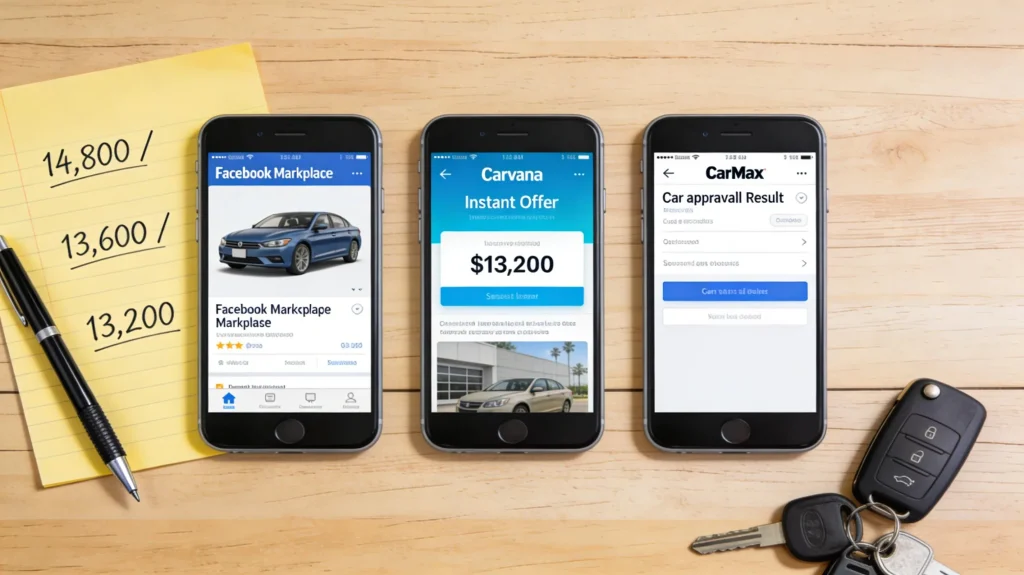
The 2026 platform comparison
| Platform | Avg. vs. Market Price | Avg. Time to Sell | Fall-Through Rate | Best For |
|---|---|---|---|---|
| Facebook Marketplace | +3.1% | 6.2 days | 15.8% | Clean-title vehicles $8K–$28K |
| Carvana | +1.2% | 48 hours | 3.1% | Speed and convenience |
| Cars.com | ~market | 10.5 days | ~12% | $15K–$35K verified buyers |
| Autotrader | ~market | 12 days | ~11% | High-value, intent-driven buyers |
| CarMax | –2.4% | Same day | 0% | Guaranteed offer, zero hassle |
| Dealer Consignment | +4.2% gross | 14–21 days | ~8% | Specialty / vehicles over $30K |
Facebook Marketplace: highest net, highest effort
For a clean-title vehicle under 80,000 miles priced between $8,000 and $28,000, Facebook Marketplace consistently delivers the highest net payout of any platform. Zero platform fees mean every dollar of the sale price stays with the seller. In Q4 2025, Facebook Marketplace sellers closed at an average of 3.1 percent above market value with a median sale time of 6.2 days.
The documented tradeoff is a fall-through rate of 15.8 percent. Buyers ghost, cancel last minute, and show up without financing confirmed at higher rates than on curated platforms. The operational fix is a structured screening process: require buyers to confirm their payment method before scheduling a showing, never hold the vehicle without a cash deposit, and respond to all inquiries within two hours. Listings with sub-two-hour response times receive 41 percent more serious follow-up inquiries than slower responders.
Carvana vs. CarMax: the instant offer decision
These two platforms are structurally different in ways most sellers don’t fully understand before committing.
Carvana generates a quote online in about 10 minutes. Their offers average 1.2 percent above market value and the transaction closes within 48 hours with a fall-through rate of just 3.1 percent. What sellers should know: the online quote is a ceiling, not a guarantee. Adjustments at pickup inspection are common on vehicles with undisclosed wear, paint issues, or unspecified mechanical items. Carvana prices most aggressively on clean-title vehicles between $15,000 and $35,000 with documented service histories.
CarMax appraises in person and honors its offer without conditional adjustments. Same-day payment, zero paperwork burden for the seller, and zero fall-through risk. The cost of that certainty runs at a consistent 2.4 percent below market average. On a $20,000 vehicle that’s approximately $480 surrendered for a guaranteed, frictionless close.
The optimized play is to get both quotes before listing anywhere publicly. Use the higher number as your floor and as a negotiation anchor on Facebook Marketplace. If your private listing hasn’t closed within 10 days, return to whichever instant offer was higher rather than continuing to drop your price.
The consignment option nobody uses
Dealer consignment is systematically overlooked by private sellers. Under this model a dealership sells the vehicle on your behalf — typically for an 8 to 12 percent commission — while you retain legal ownership until the sale closes. You gain access to their buyer network, financing options, and physical showroom traffic without managing a single buyer interaction.
For vehicles above $30,000, consignment sellers netted an average of 4.2 percent gross above market in Q1 2026. On a $40,000 truck, that gross advantage is enough to offset commission while eliminating every aspect of the seller experience. If time is not a constraint and the vehicle is above $30,000, one phone call to a local dealer about consignment terms is worth making before you post anywhere.
Matching vehicle to platform
The clearest decision framework works like this. If your car is clean-title, under 80,000 miles, and you have 7 to 10 days of flexibility and comfort with direct buyer communication — Facebook Marketplace. If you need funds within 72 hours or the vehicle has a complicated history — Carvana or CarMax, whichever quotes higher. If the vehicle is above $30,000 and time is flexible — explore consignment before committing to a platform.
The full platform-by-platform breakdown, including how EV pricing shifts the calculus in 2026, is covered in our guide to the best places to sell a used car.
How to prepare your car for sale: detailing, repairs, and staging tips
“These used car selling tips on preparation consistently return 3 to 5 times their cost — making this the highest-ROI step in the entire transaction.”
Most sellers spend weeks deciding on a price and about 20 minutes actually preparing the vehicle. That ratio is backwards. Preparation is not cosmetic housekeeping — it’s a direct multiplier on your final sale price, and it works before a buyer asks a single question.

Buyers form a price anchor within the first 90 seconds of seeing a vehicle in person. Consumer behavior research on high-value purchases consistently shows that first impressions shift willingness to pay by 12 to 18 percent before any technical evaluation occurs. A car that smells clean and looks sharp starts every negotiation from a fundamentally different position than a mechanically identical car that’s been neglected cosmetically.
The ROI case for professional detailing
A full professional detail — exterior wash, clay bar treatment, paint correction, interior deep clean, and odor elimination — runs $200 to $350 for most vehicles. On a $15,000 car, that investment returns $800 to $1,500 in added perceived value based on KBB condition tier differentials and NADA data on cosmetic condition premiums. That’s a 3x to 5x return on a single afternoon’s investment.
NADA data confirms that a well-maintained vehicle sells for 10 to 15 percent more than a comparable vehicle in poor cosmetic condition. KBB’s own condition tier spread on a $16,000 car is approximately $1,100 between Good and Very Good. Professional detailing is the most direct lever for justifying a condition tier upgrade before a buyer ever opens the door.
The one exception: vehicles under $5,000 in below-average mechanical condition. Buyers of distressed vehicles have already priced in cosmetic issues and won’t pay a premium for a clean interior on a car they’re buying as a project. For everything above that threshold, detailing pays.
The five under-$50 fixes with the highest return
If a full detail isn’t in the budget, these targeted investments consistently return $500 or more in net proceeds:
- Odor elimination ($15–$30): Buyers reduce their offer by an average of $400 when they detect cigarette smoke, pet odors, or mildew — even on mechanically sound vehicles. Surface sprays mask the problem temporarily. An ozone treatment kit eliminates the source. Run it 24 to 48 hours before the first showing, ventilate thoroughly, and follow with a light interior spray.
- Headlight restoration ($20–$40): Yellowed, hazy headlights communicate age and deferred maintenance more visibly than almost any other cosmetic issue. A DIY restoration kit takes 30 minutes and transforms front-end presentation — in photos and in person.
- Interior plastic and vinyl treatment ($10–$20): Faded, chalky dashboard panels make a cabin feel years older than it is. One application of a quality protectant restores the look in 20 minutes and signals consistent upkeep to every buyer who opens the door.
- Interior windshield cleaning ($15–$25): Haze and film on the inside of the windshield is the third most cited interior complaint in buyer feedback surveys. Buyers notice it during test drives even when they can’t articulate what’s bothering them. It takes 10 minutes to remove completely.
- Tire dressing ($10–$15): Black, dressed tires change how a car photographs and how it reads in person. Apply the morning of a showing — not the night before — so it doesn’t attract dust.
What to do about paint chips and minor dents
Minor paint chips and small parking-lot dents don’t require professional body shop repairs before a private sale. Buyers expect them on any vehicle over three years old and factor them in — but they factor them in less aggressively when the rest of the car looks genuinely well maintained.
The calculus is straightforward: if a single dent or scratch is so prominent that it’s the first thing every buyer mentions, a $150 paintless dent repair is worth considering. For everything else, clean the surrounding areas thoroughly and let the overall presentation do the work. Never attempt amateur touch-up paint on visible panels — a mismatched touch-up raises more questions than the original chip.
The engine bay that sellers always forget
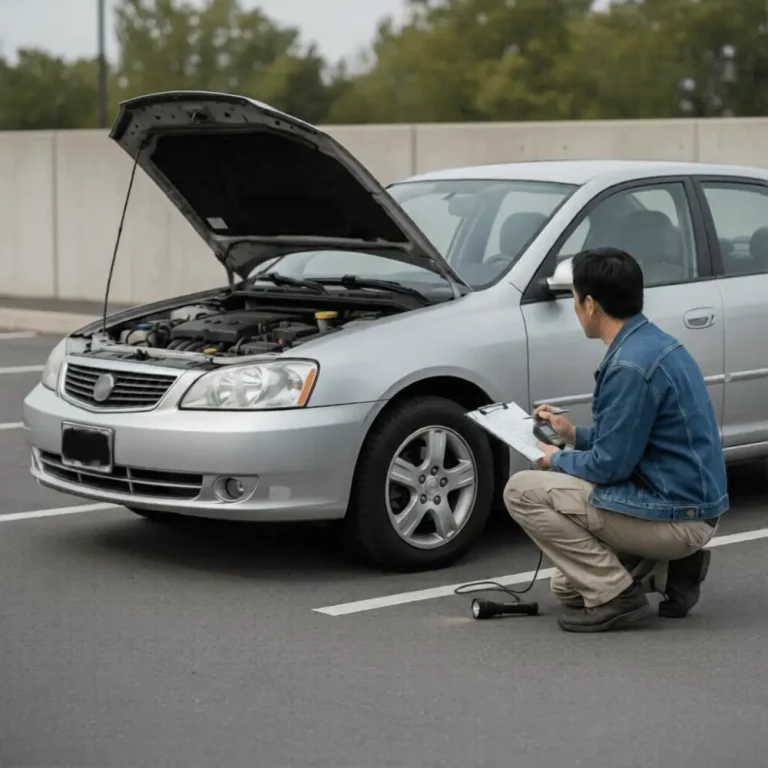
Most sellers detail the interior and exterior carefully and open the hood to a grimy, dusty engine bay. Serious buyers always look under the hood, and the contrast between a clean cabin and a neglected engine bay lands as a red flag — even if everything is mechanically sound.
You don’t need a full engine bay detail. A wipe-down of visible plastic covers, confirmation that there are no visible leaks or dirty fluid residue around caps, and a clean air filter make a meaningful difference. Check the dipstick before any showing — dark, sludgy oil on a buyer’s first visual check immediately reopens the mechanical conversation regardless of how the rest of the car presents.
The 24-hour pre-showing checklist
- Exterior hand wash and dry, tire dressing applied
- Interior vacuum — seats, carpets, floor mats, trunk
- Dashboard and door panels wiped with protectant
- Interior windshield cleaned, all glass cleaned exterior
- Odor check: sit inside with windows closed for two minutes and be honest
- Under-hood visual: fluid levels correct, no visible leaks, no debris
- All exterior lights confirmed working
- Spare tire and jack present and inflated
For the complete detailing sequence, the full ROI table by vehicle value, and specific product recommendations that professional detailers actually use, our car prep and detailing checklist for private sellers covers every step in detail.
Writing the perfect used car listing: photos, description, and keywords
Your listing is a sales document. It does a job before you ever pick up the phone: it pre-qualifies buyers, pre-answers objections, and pre-justifies your asking price. Get it right and serious inquiries come in fast. Get it wrong and the car sits while buyers scroll past it in under eight seconds.
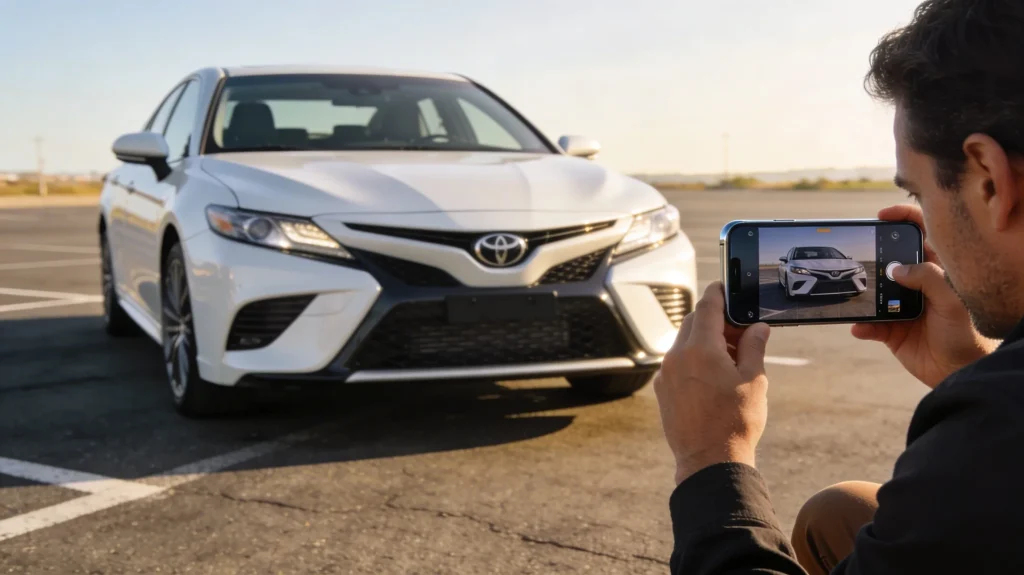
Listings with six or more quality photos receive 41 percent more serious inquiries than listings with two or three. That’s not a minor edge — it’s the difference between a car that sells in a week and one that stalls for a month with nothing but low offers and silence.
The 8-photo sequence
Every angle you skip is a question a buyer has to ask you directly — and many won’t bother asking. These eight shots cover everything a serious buyer needs to see before making contact:
- 3/4 front driver’s side: The hero shot, seen first in thumbnail view. Shoot from slightly below hood height in diffuse morning light, clean background, no distractions.
- 3/4 rear passenger side: Mirrors the first shot from the opposite corner. Together these two give buyers a complete exterior read.
- Driver’s side profile: Full length, straight on. Reveals panel alignment, long scratches, and roofline condition.
- Front straight on: Headlight condition, grille, and front bumper in one frame.
- Rear straight on: Taillights, bumper, exhaust tips, and rear badges.
- Interior from driver’s door: Shot from outside looking across both front seats — dashboard, center console, and general cabin condition in one image.
- Odometer and instrument cluster: With the car running. Confirms stated mileage and shows a clean start.
- Engine bay: Tidy, no visible leaks, fluid caps accessible and clean.
Shoot everything in the morning when light is even and diffuse. Midday sun creates harsh shadows that make paint look worse than it is. Never shoot in the rain, never shoot in a dark garage.
The five-block description formula
Block 1 — Headline facts: Year, make, model, trim, mileage, drivetrain, transmission, engine. Put these first. Buyers are scanning, not reading.
Block 2 — Condition summary: Be specific and honest. Mention what’s in excellent shape and what isn’t. Buyers who discover undisclosed issues at the showing feel deceived and the negotiation goes sideways immediately. Buyers who read an honest description arrive with calibrated expectations and close more often.
Block 3 — Service and maintenance history: Anything documented in the past 18 months is worth mentioning. Timing belt, tires, brakes, battery — these are items buyers mentally add to their cost estimate when evaluating a used vehicle. If you’ve already taken care of them, say so explicitly.
Block 4 — Title and history: Clean title, no accidents, one owner — state whatever applies. If you have a CarFax, mention it. “Clean CarFax available” is a trust signal that buyers register immediately and that directly reduces the probability of an aggressive opening offer.
Block 5 — Practical logistics: Your asking price, whether you’re open to reasonable offers, preferred contact method, and general availability for showings. One sentence confirming you welcome test drives signals confidence in the vehicle without saying so directly.
Keywords that buyers actually search for
For any used car listing, weave these into your title or description naturally:
- Full model name including trim level — not “Honda CR-V” but “Honda CR-V EX-L”
- Drivetrain designation: AWD, 4WD, FWD, RWD
- Transmission type — many buyers filter specifically for automatic or manual
- Key searchable features: sunroof, leather seats, backup camera, tow package, third-row seating
- Mileage written out as a number — “61,400 miles” not “low miles”
“Low miles, great condition, well maintained” tells a buyer nothing and ranks for nothing. “61,400 miles, one owner, clean CarFax, new rear brakes, leather interior, AWD” tells a buyer everything and surfaces in filtered searches.
Price anchoring and the $300 that protects your margin
List $200 to $400 above your actual floor price. This preserves room to move during negotiation without dropping below what you need. Three things to leave out of every listing: “price is firm,” urgency language like “must sell this weekend,” and mechanical claims you can’t document.
The complete photo checklist, the full description formula with worked examples, and the keyword list broken down by vehicle category are all covered in our guide to writing a used car listing that sells in 7 days.
How to negotiate with private buyers: scripts and proven tactics
Every serious buyer will test your price. That’s not a personal challenge — it’s simply how private car transactions work. Buyers arrive having done their own research, knowing you want to sell, and betting that a confident opening offer below your asking price will get some traction. What separates sellers who close at or near their number from those who give away $800 in the driveway is preparation. Specifically, knowing what to say before the conversation starts.
Sellers who prepare specific scripted responses close at asking price 63 percent more often than those who improvise on the spot. The scripts aren’t manipulative — they’re just structured, calm, and data-backed.
Why unprepared sellers lose money in 10 minutes
A buyer who opens with a lowball offer is running a simple test: is this seller anchored to their price, or are they just hoping for the best? Sellers who respond with hesitation, over-explanation, or immediate movement answer that question immediately. Sellers who respond with calm, specific, data-backed counteroffers reframe the exchange entirely.
The four scenarios every seller encounters
Scenario 1 — The lowball opener
The car is listed at $14,200 and the buyer opens at $12,500. Resist the instinct to split the difference immediately. The right response: “I appreciate the offer. I’ve priced this based on KBB private-party value and what similar vehicles are currently selling for locally. I can come down to $13,900 if we can close today, but that’s the bottom of what I can do.”
Scenario 2 — The issue hunter
This buyer spends 20 minutes cataloguing every minor imperfection and then uses the list to justify a price well below asking. The response is to acknowledge without conceding: “You’re right that it’s not a new car — I’ve priced it as a used vehicle in good condition, which it is. The KBB Good condition value for this exact trim and mileage is $13,800. I’m at $14,200 because the maintenance history is documented and the CarFax is clean.”
This scenario is largely pre-empted by disclosing every visible imperfection in your listing. Buyers who arrive already knowing about the door ding have no grounds to use it as a negotiating tool.
Scenario 3 — The hesitant tire-kicker
This buyer seems genuinely interested but leaves without making an offer and then goes quiet. One follow-up, 24 to 48 hours after the showing: “Hey — just following up on the CR-V. I have another showing scheduled this week and wanted to give you first right of refusal before I move forward. Let me know either way.”
Do not offer a price reduction in this message. Unprompted concessions tell the buyer your price was soft all along.
Scenario 4 — The pressure close
This buyer makes a reasonable offer but attaches artificial urgency: “I have cash right now but I can only do it today.” The calibrated response: “I appreciate the cash offer and I’m ready to close today if the number works. If you can get to $13,800, we can do the paperwork right now.”
The $500 rule
Never move more than $500 in a single counter without the buyer meeting you halfway. If your floor is $800 below asking, use it in two steps — a first counter at $500 off, a final position at $800 off if needed. Buyers who see a large immediate concession almost always push further. Buyers who see two smaller moves understand they’ve reached the end.
If a buyer won’t close within $500 of your floor after two rounds of counters, they’re probably not your buyer. The right buyer is typically 48 hours away.
Deposits and written receipts
When a buyer wants to hold the car with a deposit, write a receipt immediately — both names, the vehicle VIN, deposit amount, agreed sale price, and closing date. Take a photo of it before the buyer leaves. State clearly on the receipt that the deposit is non-refundable if the buyer backs out without cause.
For word-for-word scripts covering all four scenarios and how to handle trade-in requests and financing contingencies, our negotiation guide for private car sellers walks through every conversation in detail.
Paperwork and legal steps when selling a used car privately
This private car sale guide 2026 covers every document you need — because one missed signature can void a deal you’ve spent two weeks building.
The deal is agreed, the price is set, and the buyer is ready to hand over the money. This is exactly the moment most private sellers relax — and it’s exactly the moment where the transaction can still unravel. Incomplete paperwork, a missed signature, or a document requirement that varies by state can void the transfer, delay the title, or leave you legally liable for a vehicle you no longer own.
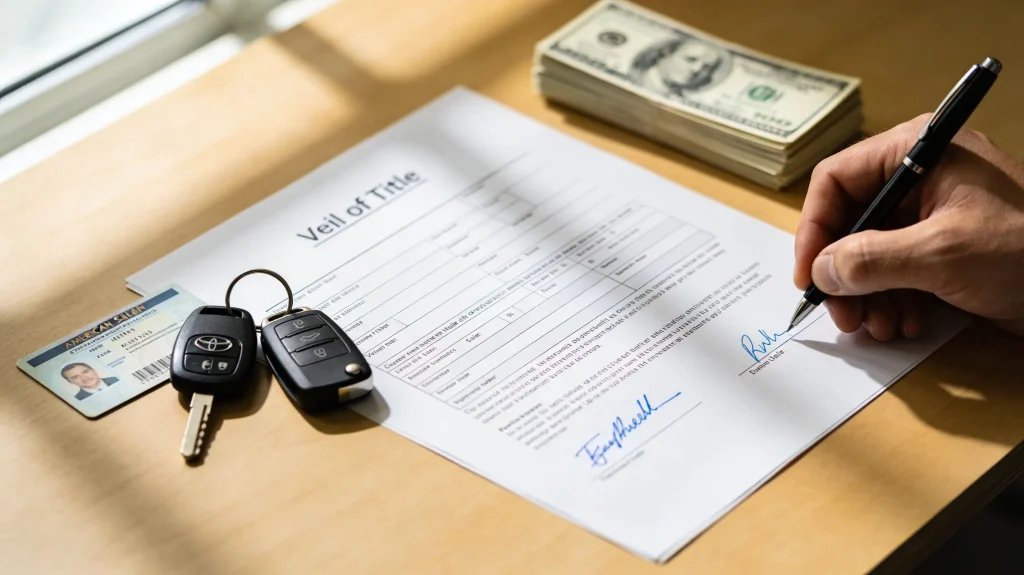
The two documents every private sale requires
Regardless of where you live, two documents are non-negotiable: the certificate of title and a bill of sale.
The certificate of title is the legal document that proves ownership and transfers it to the buyer at the point of sale. Without a properly signed and completed title, the buyer cannot register the vehicle in their name — and until they do, you remain the legal owner in the eyes of the DMV. Sign exactly as your name appears on the title. Never use white-out or correction fluid. If two owners are listed joined by “and,” both signatures are required — missing one voids the transfer.
The bill of sale is your transaction record and should include: full legal names and addresses of both parties, the VIN verified against the title, the year, make, model, and color, the exact odometer reading, the sale price in both numerals and written form, the date of sale, and an explicit as-is statement: “Buyer accepts vehicle in as-is condition. Seller makes no warranty, expressed or implied.” Both parties sign, both parties keep a copy.
The 19 states with additional requirements
Nineteen U.S. states require documentation beyond the standard title and bill of sale. The most common additional requirements are an odometer disclosure statement, an emissions or smog certificate (required in California, Colorado, Illinois, New York, and others before the buyer can register the vehicle), a safety inspection certificate (required in Missouri, Pennsylvania, Virginia, and others), and a lien release document if the title still shows a lienholder. Confirm your state’s specific requirements on your DMV website before you accept a deposit.
Selling with an outstanding loan
Contact your lender before you list. Get a current payoff amount with a per-diem rate. At closing, the buyer’s payment must satisfy the lien before any remaining proceeds go to you. The cleanest option is closing at a lender branch where the payoff is processed and the title released in a single appointment. A title company or escrow service — typically $100 to $200 — is a reliable alternative that protects both parties. Never accept payment and promise to mail the title later.
The closing day sequence
Run through this in order on the day of sale:
- Confirm the buyer’s identity with a valid driver’s license before any paperwork is signed
- Verify the VIN on the title matches the VIN plate on the dashboard
- Complete the odometer disclosure on the title
- Both parties sign the title in the correct fields, in ink, with no corrections
- Complete and sign the bill of sale — both parties keep a signed copy
- Collect payment in cash, cashier’s check, or verified electronic transfer only
- Hand over all keys, the owner’s manual, and any spare key fobs
- Remove your license plates
- File your Notice of Transfer with the DMV online — same day
- Notify your insurance company to cancel or transfer coverage
The full state-by-state document checklist, the complete bill of sale template, and a walkthrough of lien payoff options are all covered in our used car paperwork and title transfer guide.
Conclusion
Selling a used car privately is a sequence, not a single event. Each step in this guide compounds the ones before it — and the sellers who treat it that way consistently walk away with $1,500 to $3,000 more than those who skip steps or rely on instinct.
The sequence matters because each decision creates the conditions for the next one. A defensively priced vehicle attracts serious buyers. Serious buyers respond to a well-prepared car. A well-prepared car photographs well. A strong listing pre-qualifies buyers before they contact you. Pre-qualified buyers negotiate from a more reasonable starting point. And a clean negotiation closes faster with less friction on the paperwork side.
None of these steps require special expertise or expensive services. They require roughly 10 to 12 hours of deliberate preparation spread across a week — and they return that investment several times over in final sale price and time on market.
A few numbers worth keeping in mind as you work through your own transaction. Sellers who price within 3 percent of KBB private-party value sell 47 percent faster than those who overprice by 10 percent or more. A $250 professional detail returns 3 to 5 times its cost on vehicles between $10,000 and $25,000. A $40 CarFax report adds an average of $380 to closing price. And platform selection alone — choosing Facebook Marketplace over CarMax on a clean-title vehicle under 80,000 miles — is worth over $1,000 in net proceeds before any other variable changes.
The most important thing is to start in the right order. Price first, prepare second, list third, negotiate fourth, close the paperwork fifth. Sellers who reverse steps — listing before pricing accurately, or skipping prep to save a weekend — create problems downstream that cost more to fix than the time they saved.
If you’re working through this process right now and want to start with the step that delivers the fastest, most tangible return before your first showing, our car prep and detailing checklist is where the money is most immediately visible — and it’s a half-day of work that buyers will notice within 90 seconds of arrival.