Minimum auto insurance coverage laws in California

Auto insurance is not optional in California. Every registered vehicle must meet the state’s minimum auto insurance coverage requirements, yet many drivers misunderstand what those minimums actually cover and more importantly, what they do not.
California’s minimum coverage laws are among the lowest in the United States when compared to real-world accident costs. While meeting the legal minimum satisfies registration requirements, it often leaves drivers financially exposed after even a minor accident. Understanding how these laws work is essential for legal compliance, financial protection, and smart insurance decision-making.
This pillar article explains minimum auto insurance coverage laws in California, including required limits, how they are enforced, penalties for non-compliance, common misconceptions, and when minimum coverage may or may not be appropriate. It is designed as a cornerstone resource for automotive insurance niche websites and California drivers seeking accurate, state-specific guidance.
Is auto insurance mandatory in California?
Yes. California law requires continuous financial responsibility for all registered vehicles.
Drivers must maintain:
- Active liability insurance, or
- An approved alternative form of financial responsibility
Insurance status is reported electronically to the California DMV, meaning lapses are detected automatically.
California minimum auto insurance coverage requirements
California requires liability coverage only. Liability insurance covers damage you cause to others, not damage to your own vehicle.
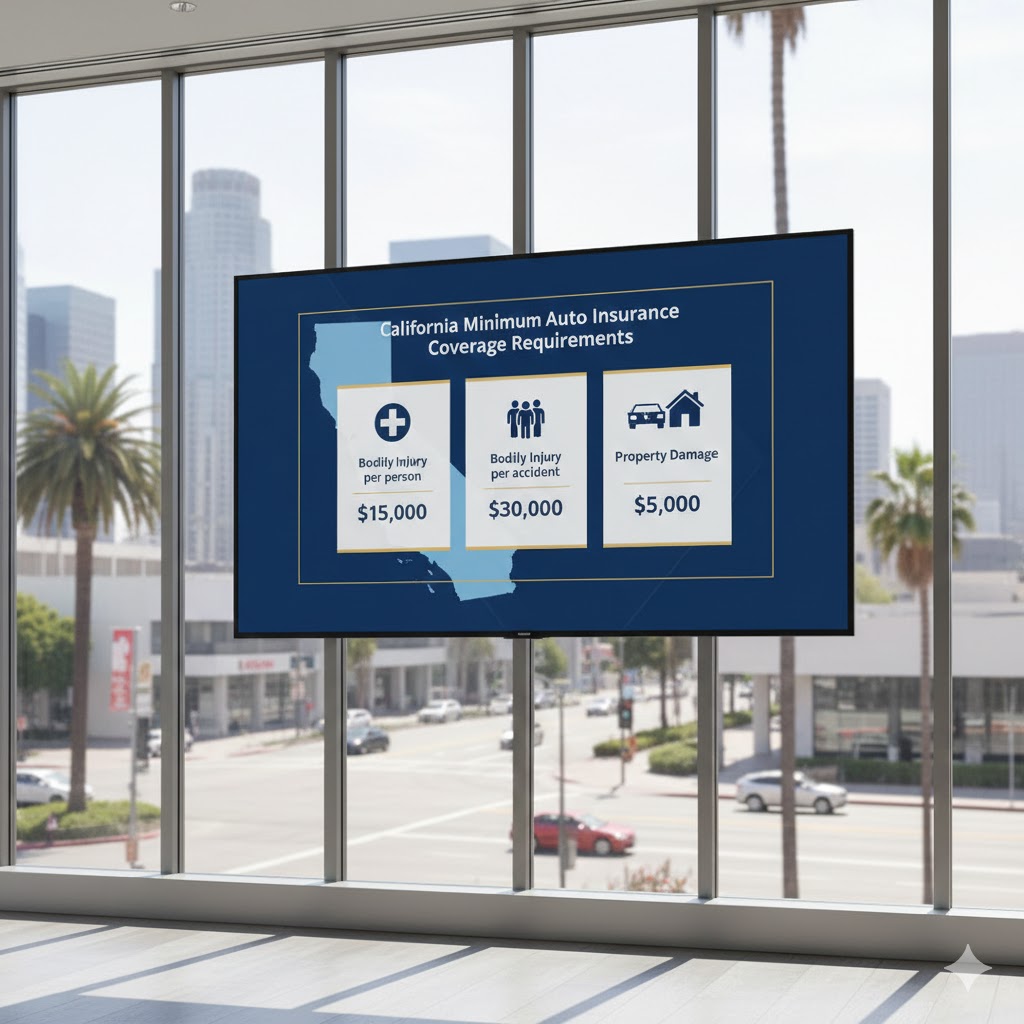
Required minimum limits (California)
- Bodily Injury Liability
- $15,000 per person
- $30,000 per accident
- Property Damage Liability
- $5,000 per accident
These limits are often written as 15/30/5.
What bodily injury liability covers
Bodily injury liability pays for:
- Medical expenses of injured parties
- Lost wages
- Pain and suffering
- Legal defense costs if you are sued
Key limitation
Medical bills can exceed $15,000 very quickly, even for minor injuries. Once policy limits are exhausted, the at-fault driver is personally responsible for remaining costs.
What property damage liability covers
Property damage liability pays for:
- Repairs or replacement of other vehicles
- Damage to buildings, fences, or structures
- Roadside property damage
Why $5,000 is often insufficient
Modern vehicle repair costs routinely exceed $5,000. Even a low-speed collision can surpass the minimum limit, exposing drivers to out-of-pocket liability.
What California minimum coverage does not cover
Minimum liability insurance does not cover:
- Damage to your own vehicle
- Theft or vandalism
- Weather-related damage
- Medical expenses for you or your passengers
- Hit-and-run damage (unless uninsured motorist coverage is added)
Drivers relying solely on minimum coverage assume significant financial risk.
Uninsured and underinsured motorist coverage
Uninsured motorist coverage is not required in California but must be offered.
This coverage protects you if:
- You are hit by an uninsured driver
- You are involved in a hit-and-run
- The at-fault driver has insufficient insurance
Many drivers add this coverage because minimum liability limits are common.
How minimum coverage is enforced in California
California enforces insurance laws through:
- DMV registration requirements
- Electronic insurance verification
- Traffic stops
- Accidents and claims reporting
Failure to maintain coverage can trigger automatic penalties.
Penalties for driving without insurance in California
Penalties may include:
- Fines
- Vehicle registration suspension
- Reinstatement fees
- Proof-of-insurance filing requirements
- Increased future insurance premiums
Driving uninsured also exposes drivers to full personal liability after an accident.
Is minimum coverage enough in California?
For most drivers, minimum coverage is legally sufficient but financially inadequate.
Minimum coverage may be considered only if:
- The vehicle has very low value
- The driver has limited assets
- The driver accepts high financial risk
Most drivers benefit from higher limits.
Why many California drivers choose higher limits
Drivers upgrade coverage to:
- Protect personal assets
- Avoid lawsuits
- Cover modern vehicle repair costs
- Reduce long-term financial risk
Higher liability limits are often less expensive than expected.
Minimum coverage and accidents in California
If you cause an accident with minimum coverage:
- Your insurer pays only up to policy limits
- You are responsible for remaining damages
- Wage garnishment or lawsuits are possible
Minimum coverage does not shield drivers from financial consequences.
Minimum coverage vs. full coverage
“Full coverage” is not a legal term but usually includes:
- Liability insurance
- Collision coverage
- Comprehensive coverage
Minimum coverage includes liability only.
How minimum coverage affects insurance pricing
Minimum coverage:
- Has the lowest premium
- Offers the least protection
- Often results in higher long-term risk
Drivers sometimes save short-term money but lose significantly after a claim.
California minimum auto insurance coverage laws define the legal floor, not the recommended standard. While meeting minimum requirements keeps vehicles registered and drivers legal, it often leaves them exposed to substantial financial risk.
Understanding what minimum coverage includes and what it does not is essential for making informed insurance decisions. For most California drivers, minimum coverage should be viewed as a starting point, not a long-term strategy.