Is diy headlight restoration safe for modern vehicles?
Many car owners hesitate to restore their headlights at home because of one key concern: is diy headlight restoration actually safe for modern vehicles? With today’s advanced materials, sensors, and lighting technology, this is a valid question.
The short answer is yes-diy headlight restoration is safe, as long as it is done correctly and with realistic expectations. In this article, we explain why modern headlights can be restored safely, where the real risks are, and how to avoid damage.
What modern headlights are made of
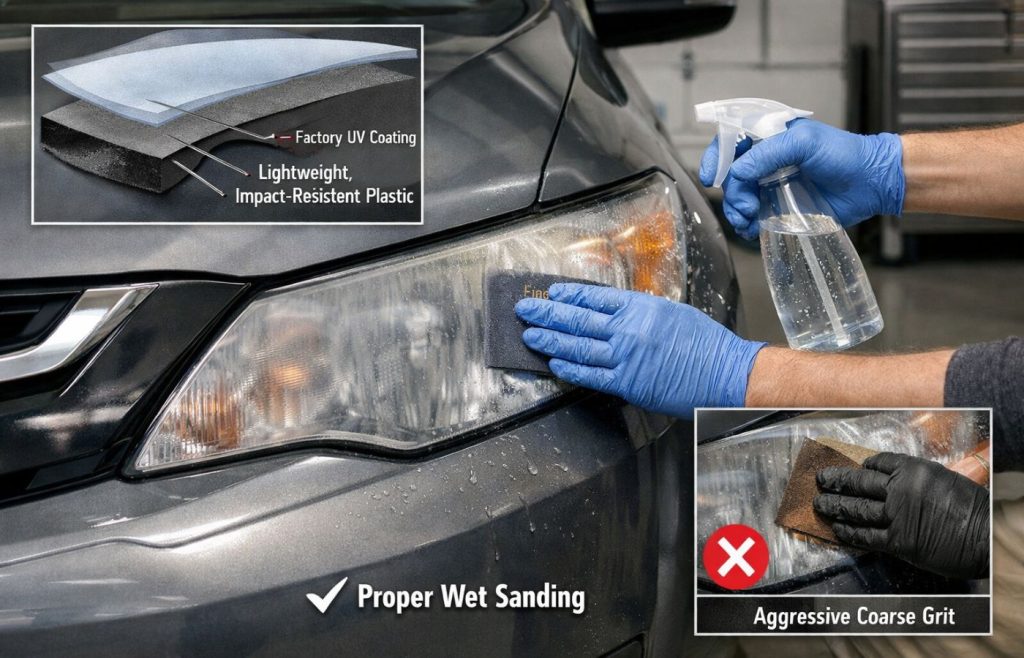
Nearly all modern vehicles use polycarbonate plastic headlights, not glass. Polycarbonate is:
- Lightweight
- Impact‑resistant
- UV‑coated from the factory
Over time, UV exposure breaks down this protective layer, causing oxidation, haze, and yellowing. Diy restoration works by removing the damaged surface layer and replacing UV protection.
Is sanding modern headlights dangerous?
Light sanding is safe for polycarbonate lenses when done properly.
Safe sanding means:
- Using fine grit sandpaper (as instructed by kits)
- Keeping the surface wet
- Applying light, even pressure
- Avoiding aggressive sanding on edges
Problems occur only when users:
- Over‑sand repeatedly
- Use very coarse grit unnecessarily
- Sand aggressively with power tools
(👉Step-by-step diy headlight restoration for beginners)
Will diy restoration damage adaptive or LED headlights?
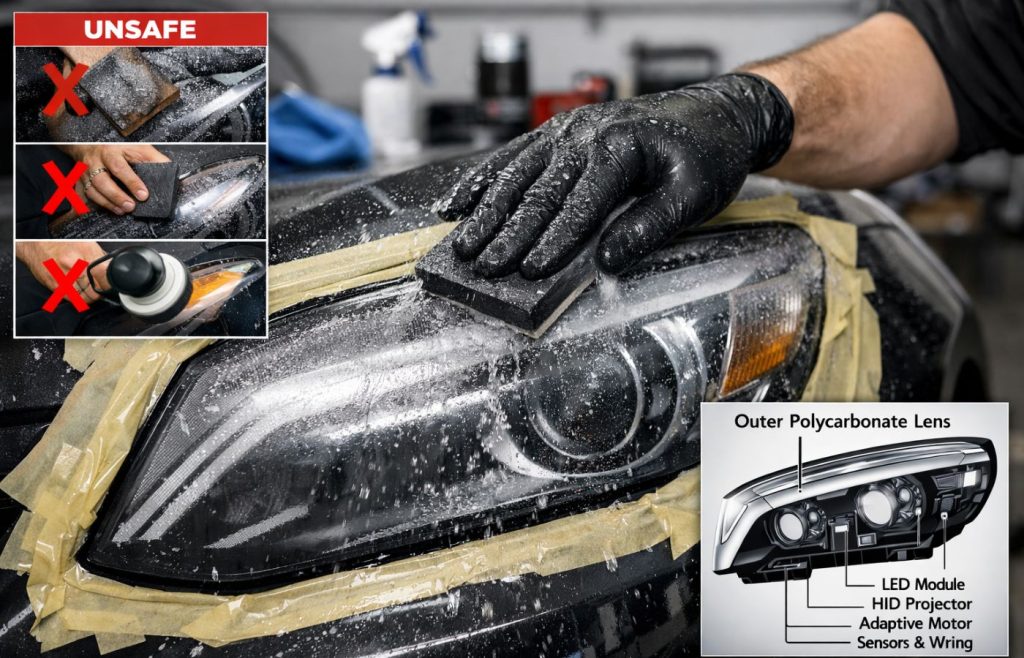
No. Diy restoration affects only the outer lens, not the internal components such as:
- LED modules
- HID projectors
- Adaptive lighting motors
- Sensors or wiring
As long as you do not open the headlight housing or use excessive heat, diy restoration does not interfere with modern lighting systems.
The real safety risk: skipping UV protection
The biggest safety and durability issue is not sanding-it’s failing to reapply UV protection.
Without UV protection:
- Headlights re‑oxidize quickly
- Visibility decreases again
- Glare can increase at night
Always apply a UV sealant or coating after sanding and polishing.
(👉 How long does diy headlight restoration last?)
How many times can headlights be safely restored?
Modern headlights can safely undergo:
- Multiple light restorations over their lifetime
- Occasional sanding followed by regular re‑sealing
To stay safe long‑term:
- Do not aggressively sand every time
- Focus on maintenance coatings between restorations
- Use the least abrasive method possible
This approach preserves lens thickness and clarity.
Diy vs professional safety comparison
| Factor | Diy restoration | Professional restoration |
|---|---|---|
| Lens safety | Safe if done correctly | Very safe |
| Risk of over‑sanding | Moderate (user error) | Low |
| UV protection strength | Medium | High |
| Cost | Low | Higher |
(👉Satellite 2: Diy vs professional headlight restoration)
Professionals reduce risk mainly through experience-not because diy is unsafe.
Vehicles where extra caution is needed
Use extra care if your vehicle has:
- Very thin headlight lenses
- Extremely sharp edges
- Older, heavily degraded headlights
In these cases, choose:
- Premium diy kits
- Minimal sanding
- Strong UV coatings
(👉 Best diy headlight restoration kits for long-lasting results)
Is diy headlight restoration safe for beginners?
Yes. For beginners, diy restoration is:
- Low risk
- Easy to control
- Forgiving when instructions are followed
Most safety issues come from rushing or ignoring steps, not from the process itself.
(👉 Common diy headlight restoration mistakes and how to avoid them)
Final verdict: is diy headlight restoration safe?
Yes-diy headlight restoration is safe for modern vehicles when:
- Proper kits are used
- Sanding is done lightly and evenly
- UV protection is always applied
For most drivers, diy restoration offers a safe, affordable way to improve visibility and appearance without risking damage to modern headlights.