

Cheap car insurance for new drivers: best options in 2026
There’s a specific kind of sticker shock that happens when you get your first car insurance quote as a new driver. You punch in your info, hit submit, and the number that comes back feels like a typo. It’s not a typo. That’s just what insurers charge when they don’t have any data on you yet.
I remember my mom’s face when she added me to her policy at 17. She didn’t say anything but I could tell the number on the screen was not what she was expecting.
The good news is that new driver rates aren’t permanent. They come down. And there are real ways to make them more manageable right now without sacrificing coverage you actually need.
Why new drivers pay so much

Insurance companies price risk. And statistically, new drivers whether they’re 16 or 26 getting their license late file more claims than experienced drivers. Not because they’re reckless necessarily, just because they haven’t built up the muscle memory and situational awareness that comes from years behind the wheel.
The less data an insurer has on you the more they hedge. A clean driving record is worth a lot over time but you have to build it first.
Age compounds this. Teenagers pay the most. Rates typically start dropping in your mid-20s for drivers who stay claim-free. By your early 30s with a clean record you’re paying something much more reasonable.
If you’re an adult getting your license for the first time, say you just moved from a city where you didn’t need a car the age factor helps but the lack of history still hurts. Most insurers treat you similarly to a younger driver until you’ve had a policy for two or three years.
What actually matters when picking a policy as a new driver
Coverage is the main thing. It’s tempting to go as minimal as possible to keep costs down but there’s a floor below which it stops making sense.
Liability only is risky when you’re a new driver. You’re more likely to have an at-fault accident in your first two years than at almost any other point in your driving life. If you cause an accident and don’t have collision coverage your own car is on you entirely.
At minimum I’d suggest carrying:
- State required liability limits (or slightly above them minimum limits are often pretty low)
- Collision coverage, especially if the car is worth more than a few thousand dollars
- Uninsured motorist because one in eight drivers around you has no insurance
Comprehensive is worth adding if the car has real value. If you’re driving a $4,000 beater, maybe not. If you’re driving something newer or financed, yes.
The companies that tend to be cheapest for new drivers
Not every insurer handles new drivers the same way. Some penalize inexperience more heavily than others.
State Farm is consistently one of the better options for young drivers, largely because of their Steer Clear program. It’s a driver training course built into their app that new drivers under 25 can complete for a meaningful discount. The discount varies by state, but it can be significant sometimes 15% or more off an already decent base rate.
GEICO doesn’t have a dedicated new driver program but their base rates are competitive and their good student discount (3.0 GPA or above) can make a real difference for students. Worth getting a quote and stacking whatever discounts apply.
Nationwide has a SmartRide program that tracks your driving habits via app or a small device in your car. For new drivers who are genuinely careful this can work in your favor. If you drive late at night a lot or have a long highway commute it can also work against you so it’s not for everyone.
Progressive is worth considering specifically if you or a parent has had an accident or ticket recently. They tend to be more forgiving of imperfect records than competitors which can matter if you’re being added to a family policy that isn’t spotless.
Staying on a parent’s policy vs. getting your own
This comes up a lot and the answer is almost always: stay on the parent’s policy if you can.
Adding a new driver to an existing policy is cheaper than that new driver getting their own policy from scratch. The parent’s history anchors the rate. The new driver benefits from a clean household record even if they don’t have one personally.
There are exceptions. If you’ve moved to a different state or you own the car in your own name, you’ll likely need your own policy. And some parents aren’t in a position to add a young driver without their own premium jumping significantly.
But if the option exists, joint policy beats standalone for new drivers almost every time.
The discounts that actually move the needle
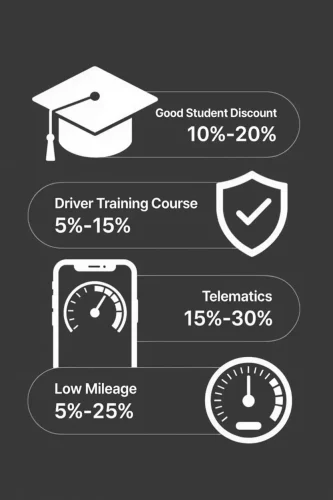
Good student discount: if you’re in school and maintaining decent grades this is usually 8 to 15 percent depending on the insurer. You typically need to show proof of GPA every year to keep it.
Driver training courses: completing an approved defensive driving course can reduce your rate in most states. Some insurers have their own programs (like State Farm’s Steer Clear), others accept third-party courses. Takes a few hours, lasts a year or more in terms of discount.
Telematics programs: apps or devices that track you’re driving. Braking, acceleration, time of day, phone usage. If you drive carefully and mostly during daylight hours these programs reward you. If you’re a night driver or have some aggressive habits, think twice.
Low mileage discounts: if you’re a student who mostly drives locally or someone who just doesn’t put many miles on the car each year, ask about this. Driving less means fewer chances to have an accident, and insurers will discount for it.
The mistake most new drivers make
Buying the cheapest policy without understanding what it covers and then being shocked when something happens and they’re not protected.
I’ve heard this from enough people that it’s worth spelling out. Cheap and appropriate aren’t the same thing. A $70/month policy that leaves you completely exposed if you cause an accident isn’t actually saving you money it’s just deferring a potentially enormous cost.
The goal is the cheapest policy that still covers what you actually need. There’s a difference.
If you want to see how rates break down across all driver types of not just new drivers but seniors, drivers after an accident, low mileage drivers the full comparison of the cheapest car insurance companies for 2026 gets into the details by profile.
One last thing
Your rate will go down. Not immediately, but it will. Every year you drive without a claim or a ticket is a year of data that works in your favor. By year three or four with a clean record you’ll be in a much better position when you shop around.
In the meantime, drive carefully, stack every discount you qualify for, and actually shop around instead of just accepting the first number you’re given. The difference between the highest and lowest quote for the same new driver can genuinely be hundreds of dollars a year.

Stay covered, stay safe, and happy driving.