
avoid dealer markups: 7 proven ways to buy used cars without overpaying
Avoid dealer markups by learning how to spot hidden fees before you commit to a used car purchase. Buying a used car should feel simple. You find a solid model, you check its condition, and you pay a fair price. The part that ruins the experience is the slow creep of dealer markups. They can show up in the sticker price, hide in fees, or even sneak into financing.
When you build your process around a complete used car buying guide, it gets harder for dealers to inflate numbers once you’re already invested.
what used car dealer markups are and how to avoid them
A dealer markup is any extra profit baked into the deal beyond a reasonable market price for that exact car in your area. It’s not always a single line that says markup. Sometimes it’s just an inflated listing price compared to similar cars nearby.
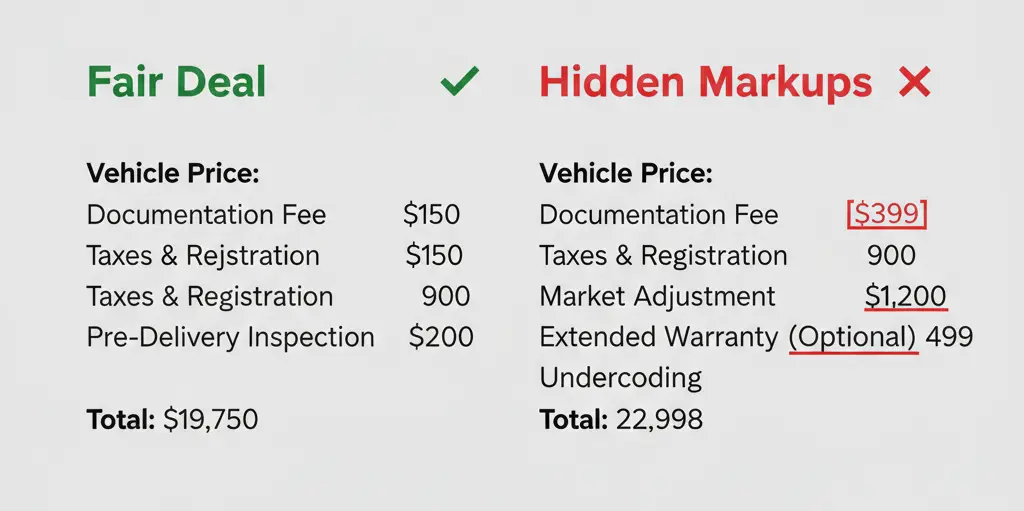
More often, the listing price looks fine and dealer markups arrive later. They come through add-ons you didn’t request, fees that feel oddly high, or a loan offer that costs more than it should. The annoying part is how normal each extra charge looks when it’s sitting on a printed worksheet.
Common places dealer markups hide:
- Add-on products you didn’t ask for, like paint protection, etching, or security packages
- Documentation or processing fees that are far above what other dealers charge
- Vague reconditioning charges with no clear details
- Financing markups through a higher APR than you qualify for
- Trade-in math that makes the deal feel balanced while the car price stays inflated
set a real price target before you talk numbers
You don’t need to be a pricing genius. You just need a fair range based on comparable listings. Once you have that range, the negotiation stops being emotional and dealer markups become easier to spot.
A routine that works:
- Pull 10 to 20 comparable listings within a realistic radius
- Match trim and drivetrain, not only the model name
- Keep mileage close. A 20k-mile difference isn’t a small detail
- Adjust for facts you can confirm, like accident history, number of owners, and tire condition
If the listing price is already high versus your comps, you know the dealer is starting from a strong profit position. If the listing price looks fair, don’t relax yet. A clean listing can still turn into a messy out-the-door total with hidden dealer markups.
Research tools like Kelley Blue Book and Edmunds provide accurate market pricing that helps you identify dealer markups before you negotiate.
quick table to keep you honest
| What to compare | Why it matters | What to do fast |
|---|---|---|
| Trim and drivetrain | Options change value | Compare the same trim level |
| Mileage band | Mileage moves price | Stay within a tight mileage range |
| Accident signals | Risk and value | Prefer clean records and clean bodywork |
| Tires and brakes | Real near-term cost | Budget for replacements if worn |
| Seller type | Fee behavior differs | Ask for out-the-door pricing early |
ask for the out-the-door price early
If you only talk about the sticker price, you’re negotiating in the dark. The out-the-door price includes taxes and fees. It’s the number you actually pay, free from hidden dealer markups.
Keep it simple and calm:
“I’m ready to move forward if the out-the-door number makes sense. Can you send the out-the-door price with an itemized breakdown including taxes and fees?”
Once you have that breakdown, you can compare two dealers without guessing. You also stop the “we’ll cover that later” habit that leads to surprises in the finance office. This transparency helps you avoid dealer markups that appear in the final stages.

remove dealer markups from add-ons with one clean decision
Add-ons aren’t always useless. The issue is price. A product that might be fine at a fair cost becomes a dealer markup when it’s priced like a luxury upgrade.
Two questions save you time:
- Is it optional?
- Can I buy it later for less?
If the answer is yes, you have leverage. Many protection packages can be purchased outside the dealership for less. Many security bundles overlap with factory features.
If they say an add-on is mandatory, ask for the written policy. If they can’t show it, you treat it as optional.
A line that works without sounding aggressive:
“I’m not including add-ons. Please remove them and update the out-the-door total.”
don’t negotiate by monthly payment
Monthly payment talk is a great way to overpay while feeling comfortable. A longer term can hide a high price. A higher APR can hide dealer markups inside a payment that fits your budget.
Keep the order tight:
- Selling price of the car
- Trade-in value, if you have one
- Fees and add-ons
- Financing rate and term
If someone tries to pull you into payments early, bring it back to price:
“I’d like to agree on the selling price first. Then we can structure financing.”
That keeps the deal transparent. It also makes it harder to shuffle numbers around and sneak in dealer markups.
use preapproval to block financing dealer markups
Even if you want dealer financing, a preapproval gives you a baseline. You stop guessing what rate you deserve. The dealer can still beat it. They just need to compete with it, which eliminates most financing dealer markups.
When a loan offer is presented, ask for:
- APR and term
- Total cost of the loan
- Any conditions tied to the rate
If the offered APR is higher than your baseline, ask why. Sometimes there’s a real reason tied to your credit profile. Sometimes it’s simply extra profit disguised as dealer markups. The Consumer Financial Protection Bureau offers free resources on auto loan rates and dealer financing practices.
negotiate like a calm technician to avoid dealer markups
Negotiation goes better when it stays boring. The goal isn’t to win. The goal is to land at a fair out-the-door number without dealer markups.
A structure that works:
- Show two or three comparable listings
- Mention one or two condition costs you can prove, like worn tires or a missing second key
- Make a clean offer
- Pause
Example wording:
“I like the car. Similar trims with this mileage are around $X to $Y. This one will need tires soon. If we can do $X out the door with no add-ons, I can leave a deposit today.”
It’s specific. It’s factual. It gives them a path to yes without room for dealer markups.
know when walking away is the smartest move
Walking away saves more money than any clever phrase. If the deal keeps changing or dealer markups keep appearing, stop feeding it time.
Walk away if:
- They refuse to give you an itemized out-the-door quote
- Add-ons return after you declined them
- The paperwork doesn’t match what you agreed to
- The numbers shift in the finance office
- You feel rushed to sign
There will always be another used car. The point is to buy the right car on fair terms, free from excessive dealer markups.
use inspection leverage without drama
A pre-purchase inspection gives you objective leverage. A shop report is hard to argue with. It also protects you from negotiating only on comps when the car’s condition says otherwise.
Ask politely if you can take the car to an independent shop. If they refuse, that’s information. You can move on. Resources like Consumer Reports provide detailed inspection checklists for used car buyers.
finish strong and avoid last-minute dealer markups
Overpaying is rarely one huge mistake. It’s a chain of small concessions that feel harmless in the moment. You avoid dealer markups by anchoring to comparable listings, insisting on an itemized out-the-door number, and removing add-ons early. You protect yourself by refusing payment-first negotiation and by bringing a financing baseline you trust.
In the middle of all that, it also helps to stay objective when shopping for a used car so the excitement doesn’t push you into a bad deal. Read every line before you sign. If the numbers don’t match what you agreed to, pause and reset. A fair deal will still be fair after a slow breath.
By following these 7 proven strategies, you’ll confidently avoid dealer markups and save thousands on your next used car purchase.