financing and leasing options for electric vehicles
Money matters when you’re buying a car. I’ve spent enough time crunching numbers on vehicle purchases to know that how you pay often matters as much as what you pay. Electric vehicles add complexity to this equation with unique incentive structures, manufacturer programs, and financing options that don’t exist for gas cars.
Most buyers focus on monthly payments without understanding the full financial picture. A $400 lease payment might seem comparable to a $380 loan payment, but the long-term costs and benefits differ dramatically. The structure of your financing affects everything from tax credit eligibility to total interest paid over the life of the agreement.
Understanding your options helps you make smarter decisions. Banks, credit unions, manufacturers, and third-party lenders all offer different rates and terms. Some specialize in EVs with preferential treatment. Others treat them like any other vehicle. Whether you’re already familiar with the complete guide to electric vehicles or just starting your research, knowing how to finance your purchase strategically can save thousands over the agreement term.
traditional auto loans for evs
Bank and credit union auto loans work the same for EVs as gas cars in most respects. You borrow money to purchase the vehicle, make monthly payments with interest, and own it outright when the loan is paid off. Simple enough, but rates and terms vary significantly between lenders.
Credit unions typically offer the best rates for borrowers with good credit. I’ve seen credit union rates as low as 3.99% for 60-month terms on new EVs. Compare that to banks charging 5.5-7% for similar loans. The rate difference on a $30,000 loan amounts to hundreds in interest over five years.
Your credit score dramatically impacts available rates. Excellent credit (740+) qualifies for the lowest rates. Good credit (670-739) adds a percentage point or two. Fair credit (580-669) pushes rates into double digits. Below 580, you’re looking at subprime rates above 15% if you can get approved at all.
Loan terms typically range from 36 to 72 months. Longer terms lower monthly payments but increase total interest paid. A $25,000 loan at 5% costs $2,645 in interest over 48 months versus $3,307 over 60 months. The $662 difference buys you lower monthly payments of $471 instead of $589.
Some lenders offer special EV financing programs with reduced rates. Bank of America, for example, has offered 0.25% rate discounts for electric vehicles. Wells Fargo has run similar promotions. These programs come and go, so it’s worth asking specifically about EV incentives when shopping for loans.
Down payment requirements vary by lender but typically fall between 10-20% for new vehicles. Putting more down reduces your monthly payment and total interest but ties up cash you might need elsewhere. With EVs, consider whether using that cash for home charging installation might provide better value than a larger down payment.
manufacturer financing deals
Automakers subsidize financing to move inventory, and EVs often get aggressive promotional rates. These manufacturer deals can beat bank rates significantly, though they come with strings attached.
Zero percent financing appears regularly on EVs. Nissan has offered 0% APR for up to 72 months on the Leaf. Chevrolet ran 0% for 60 months on remaining Bolt inventory. These deals eliminate interest charges entirely, making them mathematically superior to any traditional loan if you qualify.
The catch is that manufacturer financing often conflicts with other incentives. You might need to choose between 0% financing or a $3,000 rebate. Running the math determines which option saves more money. A $3,000 rebate on a $30,000 vehicle at 5% for 60 months saves you about $900 more than 0% financing with no rebate.
Low APR promotions between 1.9-2.9% are more common than true zero percent deals. These still beat most bank rates and usually allow stacking with other incentives. This combination often provides the best overall value when available.
Credit requirements for manufacturer financing tend to be strict. You typically need excellent credit to qualify for promotional rates. Tier 2 and 3 credit gets offered higher rates that might not beat what your credit union offers. Always compare rather than assuming the dealer’s financing is best.
Manufacturer financing usually comes through their captive finance companies like Nissan Motor Acceptance Corporation or GM Financial. These companies want your business and sometimes approve borderline credit that traditional lenders reject. If you have credit challenges, manufacturer financing might be your best option even if the rate isn’t optimal.
leasing electric vehicles
Leasing changes the financial equation significantly for EVs due to how tax credits are applied. This creates opportunities that make leasing more attractive for electric vehicles than gas cars in many situations.
The federal tax credit goes to the leasing company, not the consumer, on leased vehicles. Manufacturers typically pass this savings through reduced monthly payments or reduced capitalized cost. The key advantage is that vehicles assembled outside North America that don’t qualify for consumer tax credits still benefit lessees because the leasing company receives the credit.
This loophole makes vehicles like the Hyundai Ioniq 5, Kia EV6, and Genesis GV60 effectively eligible for the credit through leasing despite Korean assembly. The savings can make leasing these vehicles more affordable than purchasing models that do qualify for consumer credits.
Lease terms typically run 24 or 36 months with annual mileage limits between 10,000-15,000 miles. Exceeding the mileage limit costs $0.20-$0.30 per mile. Carefully estimate your annual driving when choosing mileage allowances. Buying extra miles upfront costs less than paying overage charges later.
Money factor translates to interest rate in leasing terminology. A money factor of 0.00125 equals about 3% APR. Lease rates vary by creditworthiness like traditional loans. Excellent credit qualifies for money factors around 0.001-0.0015. Fair credit might see 0.003 or higher.
Residual value represents what the leasing company expects the vehicle to be worth at lease end. Higher residuals mean lower monthly payments because you’re financing less depreciation. EVs traditionally had low residuals due to steep depreciation, but this is improving for newer models with better range and technology.
Acquisition fees and disposition fees add to lease costs. Acquisition fees range from $395-$895 and get rolled into your monthly payment. Disposition fees of $300-$500 are charged when you return the vehicle unless you purchase or lease another vehicle from the same brand.
lease vs buy decision framework
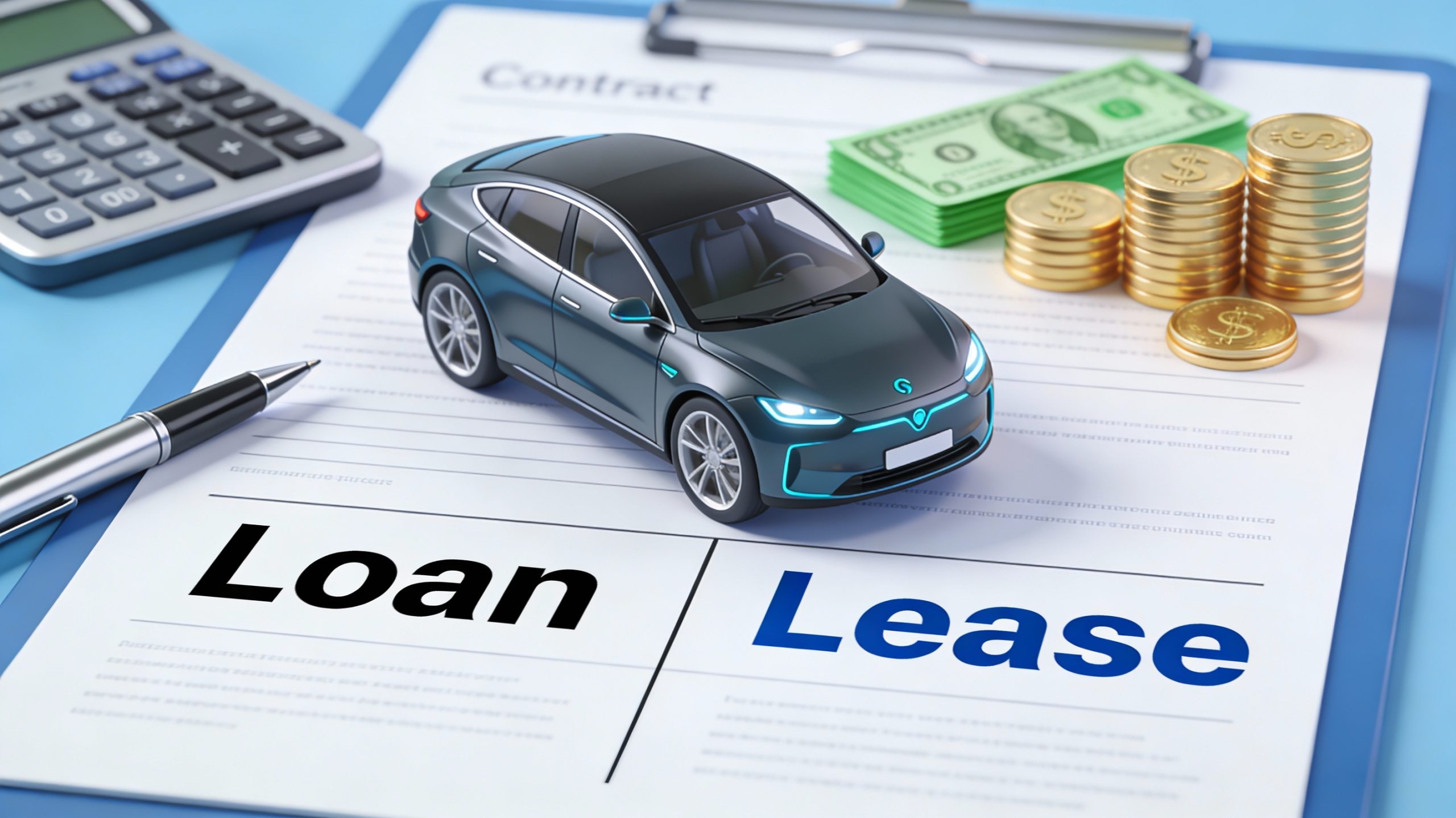
Deciding between leasing and buying depends on your priorities, financial situation, and how long you plan to keep the vehicle.
Leasing makes sense if you want lower monthly payments and like getting a new car every few years. You avoid maintenance concerns beyond basic items since you’ll return the vehicle before major repairs typically arise. Technology improves rapidly in EVs, so leasing lets you upgrade to better range and features regularly.
Buying makes sense for long-term ownership plans. You build equity with each payment and eventually own the vehicle outright. There are no mileage restrictions or wear-and-tear charges. You can modify the vehicle, drive it anywhere, and keep it as long as it runs.
Total cost comparisons reveal interesting patterns. Leasing a $35,000 EV for three years with $300 monthly payments costs $10,800 plus any down payment. At lease end, you have no equity and need another vehicle. Buying the same vehicle with $500 monthly payments for 60 months costs $30,000 total but leaves you with a vehicle worth approximately $14,000-$16,000. The buy option costs $9,200-$11,200 more out of pocket but provides $14,000-$16,000 in asset value.
The math shifts if you lease repeatedly versus buying and holding. Three consecutive 36-month leases over nine years costs roughly $32,400 in payments. Buying once and keeping the vehicle nine years costs $30,000 in payments, leaving you with a nine-year-old vehicle worth perhaps $6,000. The buy option still comes out ahead by about $3,600 plus the residual value.
Technology obsolescence matters more for EVs than gas cars. A nine-year-old EV with 2026 technology and 180-mile range might feel outdated when 2035 models offer 400 miles and autonomous features. Leasing lets you avoid being stuck with obsolete technology if advancement accelerates.
special financing programs and incentives
Beyond standard loans and leases, specialized programs target specific buyers or situations. These niche options sometimes provide advantages over conventional financing.
Some states offer low-interest loan programs for EV purchases. California’s Clean Vehicle Assistance Program provides financing as low as 5% for lower-income buyers who might not qualify for prime rates elsewhere. Other states have similar programs worth investigating.
Credit unions sometimes create EV-specific loan products with enhanced terms. Pentagon Federal Credit Union, for example, has offered rates 0.5% below their standard auto loans for electric vehicles. Ask whether your credit union has special EV programs.
Utility company partnerships occasionally include financing assistance. Some utilities partner with local credit unions to offer preferred rates to customers buying EVs. These partnerships aim to increase EV adoption to manage grid load and reduce emissions.
Workplace fleet programs can provide financing advantages if your employer supports EVs. Some companies offer salary sacrifice programs that let you lease an EV through pre-tax income, reducing your tax burden while providing convenient vehicle access.
Green lending programs from environmentally-focused lenders offer competitive rates for eco-friendly purchases. Amalgamated Bank and similar institutions provide slightly better terms for EVs and other sustainable purchases. The rate difference might only be 0.25%, but that adds up over loan terms.
negotiating your best deal
Getting favorable financing requires preparation and negotiation skills. Dealers profit from financing arrangements, giving them incentive to steer you toward options that benefit them rather than you.
Get pre-approved before visiting dealers. Having a credit union or bank approval in hand establishes your walk-away rate. Dealers need to beat that rate to earn your financing business. This leverage improves your negotiating position significantly.
Negotiate vehicle price separately from financing terms. Dealers love to focus on monthly payments because it obscures the actual price and financing costs. Insist on agreeing to the purchase price before discussing financing. This prevents them from manipulating numbers across both variables simultaneously.
Don’t reveal your pre-approved rate immediately. Let the dealer offer their best financing first. If they beat your pre-approval, you win. If they can’t beat it, you use your pre-arranged financing. Showing your hand too early removes incentive for them to compete aggressively.
Question all fees and add-ons. Documentation fees, dealer prep charges, and extended warranties pad dealer profits. Many are negotiable or can be eliminated entirely. Extended warranties on EVs provide questionable value given the existing 8-year battery warranties.
Consider timing your purchase strategically. Month-end, quarter-end, and year-end create pressure on dealers and manufacturers to hit sales targets. This pressure translates to better deals, more aggressive financing rates, and willingness to negotiate on terms they might refuse at other times.
impact on federal tax credits
How you finance affects your ability to claim federal tax credits. Understanding these rules prevents expensive mistakes.
Purchasing the vehicle outright or with traditional financing lets you claim the full $7,500 credit when filing taxes. You need sufficient tax liability to capture the benefit. If your total federal tax for the year is only $5,000, you can only claim $5,000 of the credit.
The credit is non-refundable and doesn’t carry forward. Any amount you can’t use disappears. This quirk means lower-income buyers might not benefit from the full credit even when purchasing a qualifying vehicle. Running tax projections before committing helps avoid disappointment.
Starting in 2024, some buyers can transfer the credit to dealers at point of sale. The dealer applies the credit as a down payment, reducing your financed amount. This makes the benefit immediate rather than waiting until tax time. Not all dealers participate in this program initially.
Leasing transfers the credit to the leasing company regardless of your tax situation. They receive the $7,500 and theoretically pass it through lower monthly payments. This mechanism benefits buyers who wouldn’t have sufficient tax liability to claim the credit themselves.
Business purchases follow different rules. If you’re buying for business use, Section 179 deductions and other business tax benefits might provide more value than consumer credits. Consult a tax professional to optimize your specific situation.
refinancing considerations
Your financing situation isn’t permanent. Refinancing can lower payments or reduce total interest if circumstances change or better rates become available.
Credit score improvements open refinancing opportunities. If your score increased 50-100 points since your original purchase, you likely qualify for better rates. Refinancing from 7% to 4% on a remaining $20,000 balance saves roughly $600 over the remaining term.
Market rate changes also create opportunities. If average rates dropped 1-2% since you purchased, refinancing captures those savings. Unlike mortgages, auto loan refinancing involves minimal fees, making it worthwhile even for modest rate improvements.
Timing matters with refinancing. You’ve paid the most interest in early loan months due to how amortization works. Refinancing after 12-18 months maximizes savings by reducing interest on the bulk of your remaining balance. Refinancing in the final year provides minimal benefit.
Some lenders charge prepayment penalties, though these are increasingly rare on auto loans. Check your original loan terms before refinancing to avoid unexpected fees. Most loans allow prepayment without penalty, making refinancing straightforward.
The process takes a few hours of paperwork and typically closes within a week. You’ll need your current loan information, vehicle details, and standard financial documentation. Online lenders like LightStream and Autopay specialize in refinancing and can often beat traditional banks.
common financing mistakes to avoid
Smart buyers avoid predictable pitfalls that cost money or create headaches down the road.
Focusing solely on monthly payment is the most common mistake. Dealers can manipulate payment amounts by extending terms, adding fees, or adjusting interest rates. A $400 payment over 84 months costs far more than $500 over 60 months despite seeming more affordable month-to-month.
Skipping the pre-approval step weakens your negotiating position. Without knowing what rates you qualify for elsewhere, you can’t evaluate whether the dealer’s offer is competitive. Always have a backup financing option arranged before shopping.
Rolling negative equity from a trade-in into your new loan starts you underwater immediately. You owe more than the vehicle is worth from day one. If possible, pay off negative equity separately or wait until your current vehicle’s value recovers before trading.
Buying excessive warranty and insurance products at closing adds thousands to your financed amount. Gap insurance might make sense for minimal down payment situations. Wheel and tire protection, paint protection, and interior protection rarely provide value worth their cost.
Forgetting to consider total cost of ownership leads to financing decisions that look good initially but prove expensive long-term. A lower interest rate matters less if insurance costs $100 more monthly. Factor in all ownership costs when evaluating financing options.
making your financing choice
The right financing structure depends on your credit situation, ownership plans, and financial priorities. No single answer works for everyone.
Excellent credit buyers should leverage their scores for the lowest possible rates. Compare credit union rates, manufacturer deals, and bank offers. Capture every 0.25% rate reduction since it compounds to meaningful savings over loan terms.
Challenged credit buyers should focus on getting approved first, then refinancing later once scores improve. Manufacturer financing often approves borderline credit that banks reject. Accept the higher initial rate knowing you can refinance in 12-18 months.
Short-term planners who trade vehicles frequently should lean toward leasing. The lower monthly payments and flexibility to return vehicles after three years aligns with trading habits. You avoid the negative equity cycle that plagues frequent traders who finance purchases.
Long-term holders should buy rather than lease. The higher monthly payments build equity that eventually eliminates the payment entirely. Owning outright after five years provides years of payment-free driving that leasing never delivers.
Budget-constrained buyers need to weigh lower lease payments against lacking any equity. Leasing provides affordable access to new vehicles but creates perpetual payments. Buying with longer terms costs more monthly but eventually ends, providing the most economical long-term transportation.
Understanding these financing options transforms how you approach your EV purchase. The structure you choose affects everything from addressing range anxiety and practical concerns to your monthly budget and long-term financial health. Taking time to compare options, negotiate aggressively, and choose the right structure for your situation ensures you’re getting the best possible deal on your electric vehicle journey.