real cost of ownership: budget evs vs gas cars
The sticker price comparison between electric and gas vehicles only tells part of the story. I’ve had countless conversations with people who dismissed EVs as too expensive without considering what happens after the purchase. The real financial picture emerges when you track every cost over several years of ownership.
This comprehensive view matters more for budget-conscious buyers than anyone else. When you’re stretching to afford a vehicle, understanding the true long-term costs prevents expensive surprises and reveals opportunities for savings. A gas car that costs $5,000 less upfront might actually cost $8,000 more over five years.
The math isn’t complicated, but it requires looking beyond monthly payments. Fuel costs, maintenance schedules, insurance rates, depreciation curves, and registration fees all contribute to your actual transportation expenses. Breaking down these categories reveals where electric vehicles deliver value and where they don’t. Let me walk you through the real numbers based on typical ownership scenarios.
fuel costs: the biggest difference
Electricity costs dramatically less than gasoline per mile driven. This represents the most significant ongoing savings for EV owners and the easiest to calculate.
The average American drives about 13,500 miles annually. A typical gas car averaging 30 mpg consumes 450 gallons per year. At $3.50 per gallon, that’s $1,575 annually in fuel costs. Regional variations affect this number, but it provides a reasonable baseline.
Compare that to an EV averaging 3.5 miles per kWh, requiring 3,857 kWh annually. At the national average residential electricity rate of $0.14 per kWh, you’re spending $540 per year. That’s a $1,035 annual savings, or about $86 per month.
Home charging rates vary significantly by region and time of use. California residents might pay $0.25 per kWh without time-of-use rates, raising annual costs to $964. Texas residents with $0.11 per kWh rates only spend $424 annually. Location matters more for EV fuel costs than gas prices typically vary.
Time-of-use rates can cut costs further. Many utilities offer overnight rates as low as $0.07 per kWh. Charging exclusively during off-peak hours drops annual electricity costs to $270. The savings versus gasoline become even more dramatic at $1,305 annually.
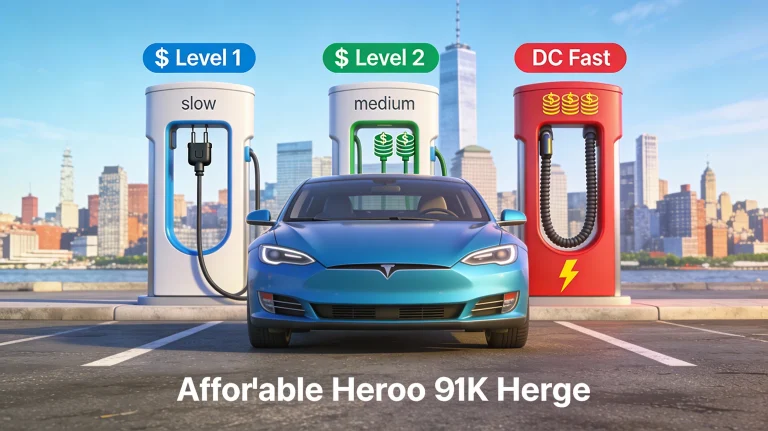
Public charging costs more but still beats gas prices. DC fast charging typically runs $0.30-$0.50 per kWh. Even at the high end, you’re spending about $1,930 annually if you exclusively fast charge. That’s still $355 less than gasoline, though the gap narrows considerably.
maintenance: where evs really shine
Electric vehicles have far fewer moving parts than gas cars. No oil changes, transmission services, spark plugs, or exhaust systems. The maintenance cost difference adds up quickly over ownership.
A typical gas car requires oil changes every 5,000-7,500 miles. That’s two or three changes annually at $50-$80 each, totaling $100-$240 per year. Add air filter replacements, spark plugs every 30,000 miles, transmission fluid services, and coolant flushes, and you’re easily spending $500-$700 annually on routine maintenance.
EVs eliminate most of this. Brake fluid flushes every few years and cabin air filters represent the main regular maintenance items. Regenerative braking means brake pads last 75,000-100,000 miles instead of 30,000-40,000. Annual maintenance typically runs $100-$150 for most EVs.
Tire costs remain similar between EVs and gas cars, though EVs wear through tires slightly faster due to instant torque and additional weight. Budget $600-$800 per set every 40,000-50,000 miles regardless of powertrain. This isn’t a cost advantage for either option.
The maintenance savings over five years amounts to $2,000-$2,750 for a typical driver. That’s conservative, assuming no major repairs on the gas car. Transmission problems, exhaust system failures, or engine issues can add thousands in unexpected costs that EVs simply don’t face.
Warranty coverage matters here. Most EVs come with 8-year, 100,000-mile battery warranties and similar coverage on drive units. Gas cars typically offer 3-year, 36,000-mile bumper-to-bumper warranties. The extended EV coverage provides peace of mind during the highest ownership costs years.
insurance rates: a mixed picture
Insurance costs for EVs vary more than fuel or maintenance expenses. Some carriers charge premiums comparable to gas cars. Others add 10-20% surcharges based on higher repair costs and limited body shop expertise.
I’ve found insurance quotes for a Nissan Leaf typically run 5-15% higher than a comparable gas Sentra. The gap narrows for more mainstream EVs as insurance companies accumulate claims data and body shops gain experience. Early EVs faced bigger surcharges simply due to unfamiliarity.
Higher vehicle values drive some of the insurance cost difference. A $35,000 EV costs more to insure than a $28,000 gas car regardless of powertrain. When comparing vehicles at similar price points, the insurance gap shrinks considerably.
Some insurers offer EV-specific discounts recognizing lower accident rates and reduced fire risk. Geico, State Farm, and others provide 5-10% discounts for electric vehicles in certain states. Shop around rather than assuming your current carrier offers the best rate.
Regional variations significantly impact insurance costs. Urban areas with higher theft and accident rates charge more for all vehicles. Rural areas with longer emergency response times sometimes add EV surcharges. Your specific location matters as much as the vehicle itself.
Budget about $100-$200 more annually for EV insurance compared to a similar gas car. This assumes you shop for competitive rates rather than accepting the first quote. Over five years, that’s $500-$1,000 in additional costs that offset some of your fuel savings.
depreciation: the real wild card
Depreciation represents your largest ownership cost regardless of powertrain. Understanding how EVs and gas cars lose value differently helps predict your total cost of ownership accurately.
Electric vehicles historically depreciated faster than comparable gas cars. A three-year-old EV typically retained 45-50% of its original value compared to 55-60% for gas equivalents. This steep depreciation hurt early adopters but creates opportunities for used buyers.
The depreciation gap is narrowing for newer EVs with longer range and better technology. Tesla Model 3 and Model Y depreciation curves now match or beat comparable luxury gas sedans. Mainstream EVs like the Hyundai Ioniq 5 show improving residual values as the technology matures.
Federal tax credits complicate depreciation calculations. If you claimed a $7,500 credit, your effective purchase price was lower from day one. That cushions depreciation impact even if the vehicle’s market value drops more steeply. A $35,000 EV that cost you $27,500 after credits can depreciate more and still leave you ahead.
Gas car depreciation follows more predictable patterns. Compact sedans typically lose 50-55% over five years. Trucks hold value better at 40-45% depreciation. Luxury vehicles fall hardest at 60-70% loss. These established patterns make gas car residual values easier to estimate.
Consider a $30,000 gas car versus a $35,000 EV after a $7,500 credit (net $27,500). After five years, the gas car might be worth $15,000 (50% retention) while the EV fetches $14,000 (40% retention of pre-credit price). You’ve lost $15,000 on the gas car versus $13,500 on the EV. Depreciation actually favored the EV despite steeper percentage losses.
registration and fees
State registration fees vary wildly and some states specifically target EVs with additional charges. These fees can add hundreds annually in some locations.
Many states calculate registration based on vehicle value. Higher EV prices mean higher registration fees in these states. A $35,000 EV costs more to register than a $28,000 gas car regardless of other factors.
Some states impose special EV registration fees to compensate for lost gas tax revenue. These range from $50-$200 annually. Georgia charges $213. Washington adds $150. These fees explicitly target EV owners and reduce your overall savings.
Other states waive or reduce EV registration fees to encourage adoption. Colorado offers reduced fees for EVs. Some states exempt EVs from emissions testing requirements, saving $15-$30 annually. These small benefits add up over ownership.
Factor in about $50-$200 annually in registration cost differences depending on your state. Over five years, that’s $250-$1,000 that either increases or decreases your total EV ownership costs. Check your specific state’s policies before assuming EVs cost more or less to register.
real-world example: nissan Leaf vs honda civic
Let me break down a concrete comparison using two popular budget vehicles. A 2024 Nissan Leaf S starts around $28,140 while a 2024 Honda Civic LX lists at $24,650. After the $7,500 federal credit, the Leaf costs $20,640 effectively.
Purchase price advantage goes to the Leaf at $4,010 less after incentives. You’re starting ahead financially before driving a single mile.
Fuel costs over five years (67,500 miles): Civic burns 2,250 gallons at $3.50 each for $7,875 total. Leaf uses 19,285 kWh at $0.14 per kWh for $2,700. The EV saves $5,175 on fuel.
Maintenance over five years: Civic requires routine service totaling approximately $2,500 (oil changes, filters, transmission service, coolant). Leaf needs minimal service totaling about $750 (brake fluid, cabin filters, tire rotations). The EV saves $1,750.
Insurance over five years: Civic costs roughly $5,000 total. Leaf runs about $5,500 due to higher value and repair costs. The gas car saves $500 here.
Depreciation after five years: Civic worth approximately $12,000 (loss of $12,650). Leaf worth approximately $11,000 (loss of $17,140 from original price, but only $9,640 from your net cost). The EV loses $2,990 less in actual dollars from your pocket.
Registration fees over five years: Assuming a state with no EV surcharges, costs are similar at roughly $500 each. Call this even.
Total five-year costs: Civic costs $24,650 purchase minus $12,000 residual plus $7,875 fuel plus $2,500 maintenance plus $5,000 insurance plus $500 registration equals $28,525. Leaf costs $20,640 purchase minus $11,000 residual plus $2,700 fuel plus $750 maintenance plus $5,500 insurance plus $500 registration equals $18,590.
The Leaf costs $9,935 less over five years of ownership. That’s nearly $10,000 in savings despite starting at a higher sticker price. The math clearly favors the EV for budget-conscious buyers who can handle the lower upfront range.
when gas cars make more sense
EVs don’t win every comparison. Certain situations favor keeping a gas vehicle or choosing one over an electric alternative.
High annual mileage drivers who can’t charge at home face different math. If you’re driving 25,000 miles annually and relying on public fast charging at $0.40 per kWh, your fuel costs jump to $2,857 per year. That’s still less than gas, but the gap narrows to $1,218 annually. Combined with higher insurance and potential depreciation concerns, the total cost advantage shrinks.
Rural drivers without reliable home charging access struggle with EV practicality. Installing charging where it doesn’t currently exist can cost $2,000-$5,000. That upfront expense changes the financial equation significantly.
Cold climate operation reduces EV efficiency by 20-40% in winter. Your effective fuel costs increase proportionally. A Leaf in Minnesota might use 25-30% more electricity than the same car in California. This regional variation affects the fuel savings calculation.
Buyers planning to keep vehicles beyond 10 years face battery degradation concerns. While warranties cover catastrophic failures, gradual capacity loss isn’t covered. A 10-year-old EV with 75% battery capacity is less useful than a 10-year-old gas car with normal wear. This matters more for buyers planning ultra-long ownership.
Towing capability matters for some buyers. Most affordable EVs can’t tow meaningful loads. If you need to pull trailers regularly, budget gas cars or trucks remain the practical choice. The few EVs with towing capacity cost more than budget options.
the wild card: electricity rate changes
Future electricity costs introduce uncertainty into long-term EV ownership projections. Unlike relatively stable gas prices over decades, residential electricity rates could shift dramatically as utilities invest in infrastructure and transition to renewable sources.
Some analysts predict electricity rates rising 3-5% annually as grid modernization costs get passed to consumers. If your $0.14 per kWh rate becomes $0.20 over five years, your annual EV fuel costs increase from $540 to $771. Still cheaper than gas, but the advantage shrinks.
Time-of-use rates becoming mandatory could cut costs or increase them depending on your charging habits. Drivers who can consistently charge overnight save money. Those needing flexibility to charge during peak hours might pay more than today’s average rates.
Home solar changes the equation entirely. If you install solar panels and charge your EV with self-generated electricity, your fuel costs drop to essentially zero after recovering the solar installation investment. This scenario maximizes EV financial benefits but requires upfront capital and suitable home conditions.
making the right choice for your situation
Total cost of ownership analysis helps you make an informed decision, but your specific circumstances determine which vehicle makes more financial sense.
Calculate your personal fuel costs based on local electricity and gas prices. National averages don’t matter if you live in Hawaii with $0.33 per kWh electricity or North Dakota with $2.80 per gallon gas. Use your actual rates for accurate projections.
Factor in available incentives realistically. Don’t count on programs that haven’t been funded yet or assume current programs will exist when you’re ready to buy. Base your calculations on what’s guaranteed today.
Consider your planned ownership period. The longer you keep a vehicle, the more fuel and maintenance savings accumulate. If you typically trade cars every three years, the benefits are smaller than keeping one for eight years.
Assess your driving patterns honestly. If most of your miles are highway road trips, an EV’s city efficiency advantage diminishes. If you drive 8,000 miles annually instead of 13,500, all the per-mile savings scale down proportionally.
Understanding these real costs rather than just comparing monthly payments reveals the true financial impact of your vehicle choice. While budget EVs often win on total ownership costs, the advantage varies based on individual circumstances. For many buyers exploring financing and leasing options for electric vehicles, these long-term savings make higher monthly payments worthwhile. The key is running the numbers for your specific situation rather than relying on generic comparisons.