
How car insurance actually works (from someone who learned the hard way)
I’ll start with something embarrassing. I drove for three years before I really understood what I was paying for every month. I knew I had insurance, could name my company, roughly what I paid. But if something actually went wrong? Zero clue what happened next.
Pretty sure I’m not alone. Most people just sign up for whatever their parents had, or whatever the dealership pushed when they bought the car, then keep hitting “renew” every year without thinking about it.
So, this is what I wish someone had handed me when I was 22, standing in a parking lot with a dented bumper, wondering if I should call my insurance or just quietly pay for it myself and hope nobody noticed.
The basic deal
You give an insurance company money every month. If something bad happens to your car or because of your car they pay for certain things. That’s the whole idea.
Where it gets messy is figuring out what “certain things” actually means. Because that depends on what policy you bought, and honestly? Most people never really look.
Car insurance is legally required in almost every state. The reason is simple: if you crash into someone and wreck their car, or worse, send them to the hospital, somebody has to pay. Without insurance, that somebody is you. Personally. And if you don’t have the money? They can garnish your wages for years. Not fun.
The coverage types that actually matter
I’ll walk through these in normal human language, since the official versions read like they were written by lawyers billing by the hour.
Liability (you can’t skip this)
Required in 49 states. New Hampshire is the weird exception, though even they have laws that basically force you to get insurance anyway.
Liability covers damage you cause to other people. Their car, their medical bills, their stuff, wages they lose if they can’t work. Rear-end someone at a light? Your liability fixes their bumper. Your car? Not their problem.
Here’s what trips people up: liability has limits, and state minimums are shockingly low. In California, the minimum is 15/30/5. That’s $15,000 per injured person, $30,000 total per accident, $5,000 for property damage. I once saw someone tap a Tesla at a stoplight. $18,000 in damage. The at-fault driver had minimum coverage. He paid $13,000 out of pocket.
My advice: never go below 100/300/100. That’s $100k per person, $300k per accident, $100k for property damage. Costs maybe $15 more per month than state minimums. Can literally save you from financial ruin.
Collision (for when you hit things)
Fixes your car after a crash. You hit something, something hits you, fault doesn’t matter you pay your deductible, they cover the rest.
Usually optional unless you’re financing or leasing. Then the lender requires it, because they want to protect their investment.
Comprehensive (for when things hit your car)
Everything that’s not a crash. Theft, hail, flooding, tree branches, someone keying your door, deer with bad timing. My coworker had a squirrel chew through her wiring last spring comprehensive claim. So yes, squirrels count.
Also covers windshield chips and cracks in most places.
PIP Personal Injury Protection (depends on where you live)
This one’s geographically weird. PIP covers medical costs for you and your passengers after an accident, no matter who caused it.
Twelve states plus Puerto Rico require PIP because they’re “no-fault”: Florida, Hawaii, Kansas, Kentucky, Massachusetts, Michigan, Minnesota, New Jersey, New York, North Dakota, Pennsylvania, and Utah. Three of those actually let you choose between no-fault and traditional.
Most other states don’t have PIP at all. Instead you might get offered Medical Payments (MedPay), which is similar but usually more limited.
The trap I see constantly: Someone moves from California to Florida, keeps their California policy. Has an accident in Florida. Their policy doesn’t meet Florida’s requirements, and suddenly they’re personally on the hook for $40,000 in medical bills. Check your coverage when you move states. Seriously.
Uninsured/Underinsured Motorist (seriously underrated)
About 14% of American drivers have zero insurance roughly 1 in 7. But it varies wildly. New Jersey? Only 3%. Mississippi? 29%. If an uninsured driver totals your car and you don’t have this coverage, you’re basically trying to squeeze money from someone who probably doesn’t have any.
Underinsured coverage helps when the other driver has insurance, just not enough. Given how low state minimums are, this happens all the time.
I always carry both. In high-uninsured states, this isn’t optional it’s essential.
The deductible thing (where people get confused)
Your deductible is what you pay before insurance kicks in. $500 deductible, $1,800 repair bill you pay $500, they pay $1,300.
Higher deductible = lower monthly payment.
Lower deductible = higher monthly payment, but less sticker shock when something happens.
Here’s what I’ve learned: the relationship isn’t linear. Bumping from $250 to $500 usually saves 12-15%. $500 to $1,000 saves maybe 8-10%. $1,000 to $2,000 might only save 4-6%. Eventually you’re taking on a ton of risk for not much savings.
There’s no perfect answer for everyone. I keep mine at $750 because I know I could scrape that together in an emergency without eating ramen for three months. If your savings account is basically empty right now, pay more monthly for a lower deductible. You’ll thank yourself later.
Some insurers offer diminishing deductibles every year you don’t file, your deductible drops by $100. Worth asking about.
Why your neighbor pays less (even on the same street)
Same zip code, similar cars, totally different bills. Insurance companies aren’t pricing “person with car.” They’re pricing your specific risk.
Your driving record. Accidents and tickets stick around for 3-5 years. A DUI can haunt you for a decade, and some insurers will just refuse to cover you.
Your age. Under 25 costs more because statistics. Not personal, just math. Rates usually drop at 25, 30, and 35 if you keep your nose clean.
Your exact location. I moved from suburbs to city and watched my premium jump. More traffic, more theft, more fender benders. Insurers know which specific blocks generate claims. In some cities, moving two miles changes your rate by 30%.
Your credit score. In most states, this matters. The theory controversial but baked in is that people who manage money well also drive carefully. Six states ban this: California, Hawaii, Massachusetts, Michigan, North Carolina, and Pennsylvania. Everywhere else, improving your credit from “fair” to “good” can save $200-400 yearly.
Your car. Sports cars, luxury brands, anything expensive to fix or easy to steal. Electric vehicles are getting pricey to insure because battery packs run $15,000+ and not many shops can handle them.
“Full coverage” vs. minimum coverage (and why “full coverage” is kind of a scam)
“Full coverage” isn’t a real insurance term. It’s marketing. Usually means liability + collision + comprehensive.
But here’s the problem: it doesn’t mean the same thing everywhere. One company’s “full coverage” includes rental cars and roadside assistance. Another’s doesn’t. The only way to know what you actually bought is reading your Declarations Page the document listing every coverage, limit, and deductible. Boring, but necessary.
Minimum coverage = only what your state requires. Usually just liability. Cheaper, but if you cause a crash, your own car is toast.
Should you get “full coverage”?
Depends. Can you write a check to replace your car tomorrow? If not, insure it.
New car, financed car, car you’d be devastated to lose: full coverage makes sense.
Older paid-off car: do the math. If collision and comprehensive cost more than 10% of what the car’s actually worth, you might be over-insuring. I knew someone paying $1,400 yearly to cover an $8,000 car. After three years, she’d paid more in premiums than the thing was worth.
Exception: if you have zero emergency fund and absolutely need your car for work, keeping coverage on an older car might be worth it for peace of mind, even if the math is iffy.
The one thing I wish I’d known at 22
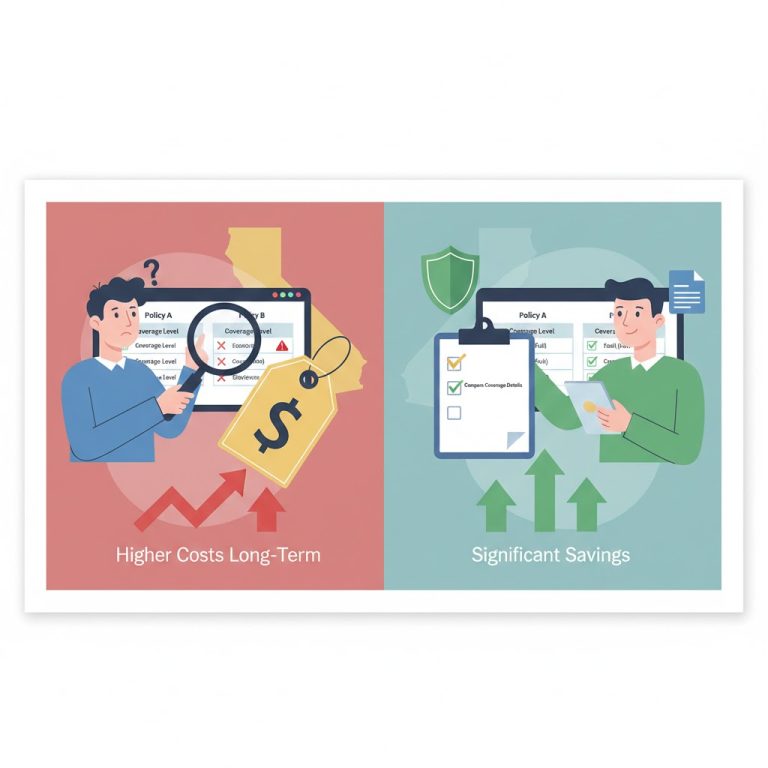
Shop around. I stayed with the same company for four years because changing sounded annoying. When I finally compared, identical coverage was $340 cheaper elsewhere. That’s $340 I just… gave away.
Rates vary massively between companies because they weight things differently. One insurer might crush you for a speeding ticket; another shrugs it off. One loves your credit score; another cares more about your annual mileage.
If you want to see which companies, actually come out cheapest for different situations young drivers, accidents on your record, whatever check out the full breakdown of cheap car insurance companies for 2026 before your next renewal.
When to file a claim vs. when to just pay
I used to think you should file for everything. Turns out, no.
Filing can raise your rates at renewal. For small stuff little dent, cracked mirror, $400 parking lot scrape paying out of pocket often saves money long-term.
Rough math: if the claim saves you less than the premium increase over the next 2-3 years, skip it.
Exceptions:
- Not-at-fault claims usually hurt your rates less (though some states allow increases anyway).
- Accident forgiveness: some insurers offer this as an add-on or loyalty perk. Protects you from that first at-fault increase.
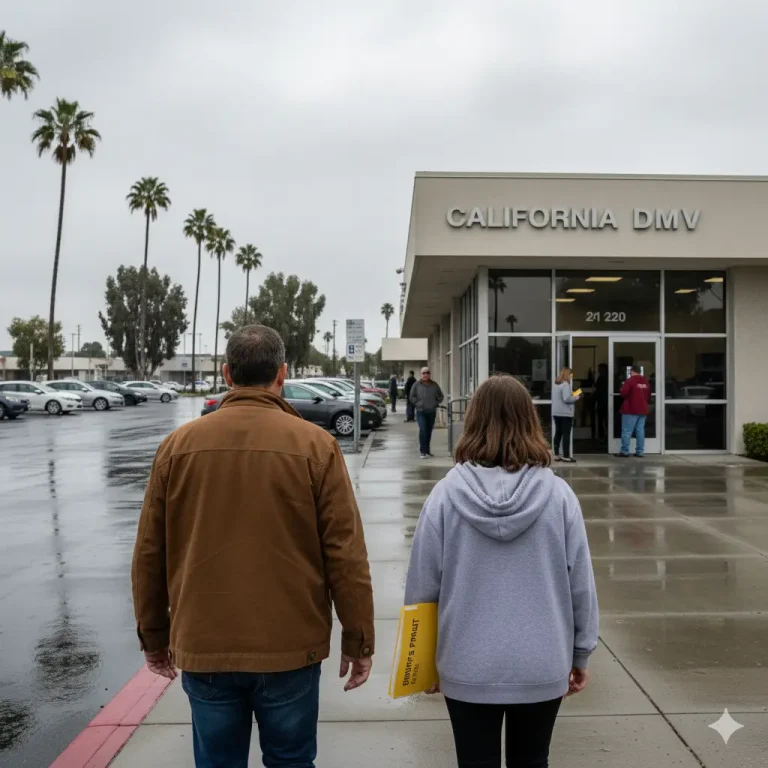
- State reporting rules: some places require you to report any accident to the DMV, insurance claim or not. Check your state’s requirements.
Definitely file when:
- Anyone got hurt (even “just a little” injuries have a way of getting expensive)
- Another driver was involved (fault disputes get messy)
- Damage is over ~$1,500
- Your car was stolen or vandalized
Five questions that separate smart buyers from surprised ones
After years of seeing what goes wrong, these are the questions that actually matter:
1. “What are my exact liability limits? Are these state minimums?” If yes, ask about 100/300/100. The upgrade is cheap; the protection is huge.
2. “Am I covered driving into Canada or Mexico?” Most policies cover Canada. Mexico? Almost never without separate insurance.
3. “Is anyone in my household excluded from this policy?” Some insurers automatically exclude household members unless specifically listed. Your roommate borrows your car and crashes? Might be uncovered.
4. “Do I have loss of use coverage, and what’s the daily limit?” Pays for a rental while your car’s in the shop. Without it, you’re paying out of pocket or taking the bus.
5. “How long do I have to report a claim? Does it vary by type?” Some policies want immediate notice for theft but give 30 days for damage. Miss the window, they can deny you.
The TL; DR
Liability covers others when you mess up get way more than the minimum. Collision and comprehensive cover your car. Your deductible is your share of the bill. Your rate depends on your record, age, car, credit (in most states), and exact address.
“Full coverage” is marketing fluff read your Declarations Page. PIP exists in some states, not others. Uninsured motorist coverage is crucial in certain places.
You don’t need to become an insurance nerd. Just understand enough to ask decent questions, read what you’re signing, and actually compare prices every few years.
If you’re trying to figure out what you should actually pay new driver, recent accident, older car, whatever this breakdown by driver type gets into specifics that a general guide can’t cover.
Stay covered, stay safe, and maybe avoid the squirrels.