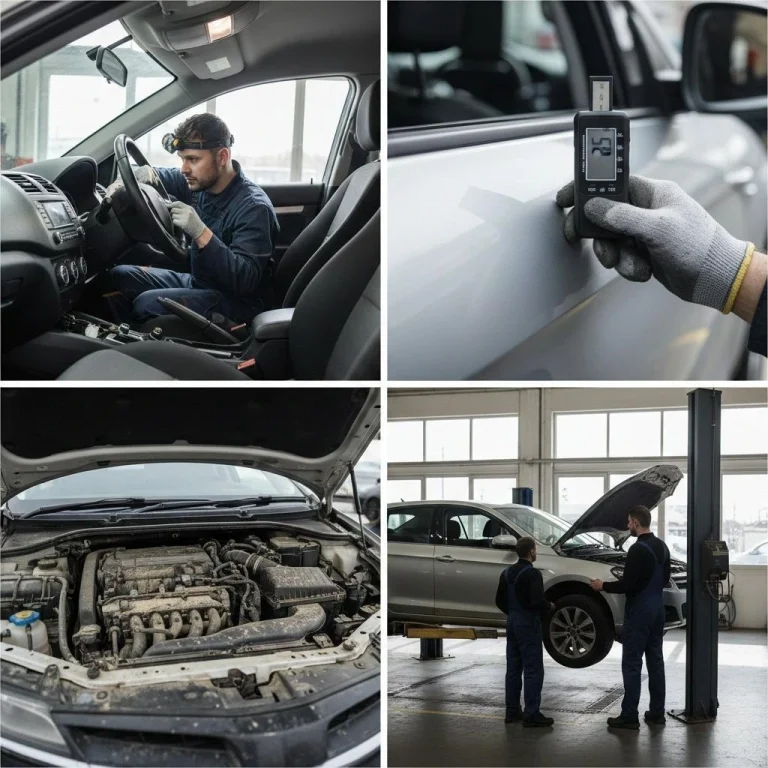
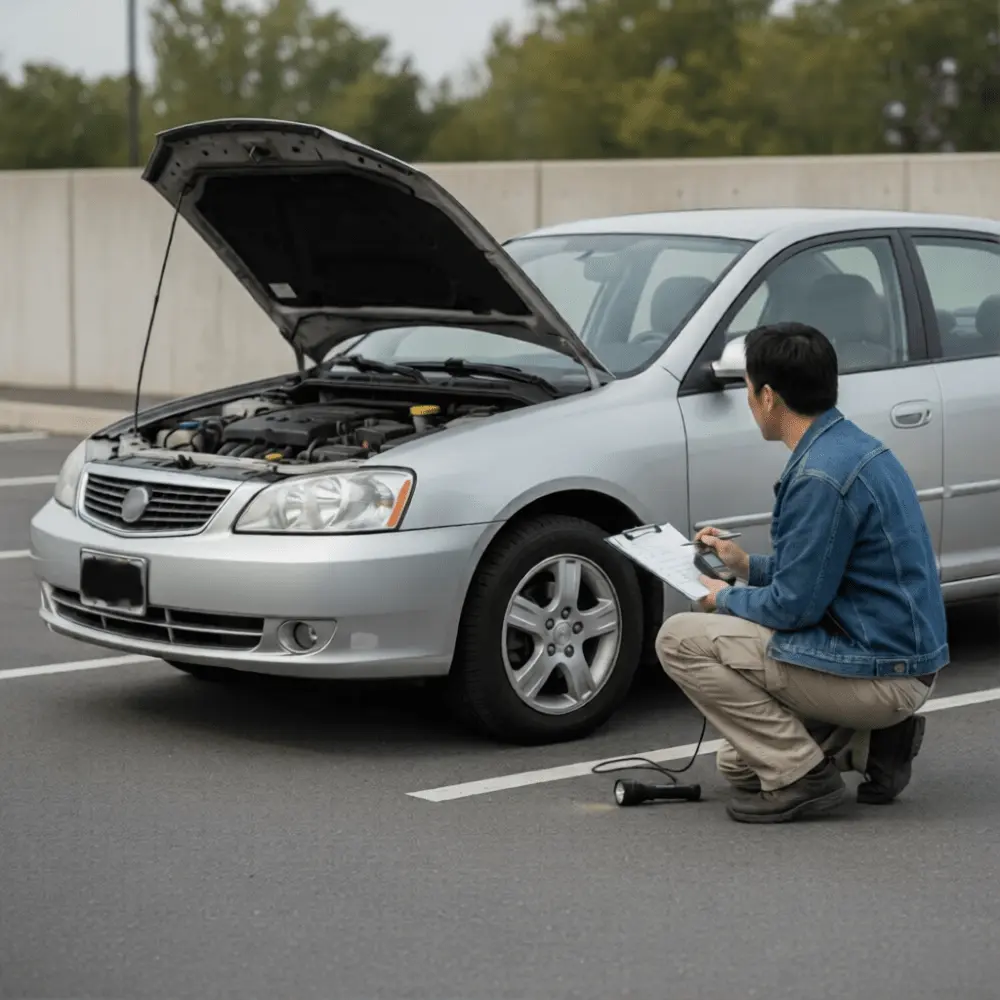
Used car inspection checklist: mistakes to avoid and red flags
Buying a used car can feel like a gamble when you do not have a system. The good news is that most expensive surprises leave clues early. You just need a repeatable routine that protects you from rushed decisions, hidden fees, and cars with problems that only show up after the first week. I’m Victor. I’m 35, I like cars and tech, and I trust simple checklists because they keep me honest. When you follow a used car inspection checklist every time, you will spot more red flags in one afternoon than most buyers notice in a month.
Section 1. Pre-purchase research: price, history, and dealership vs private seller
Before you see the car, you can avoid half the mistakes by doing the quiet work. Research is where you learn what the car should cost, which listings look risky, and what kind of seller you are dealing with. It is also where you decide what you will not compromise on.
Start with the right shortlist
Do not fall in love with one listing. Shortlist at least three comparable cars. Match trim and drivetrain, not just the model name. Keep mileage in a similar band because mileage changes value and expected maintenance.
A simple rule helps. If you cannot find at least five comparable listings in your area, widen your search radius or pick a more common model. A rare spec is harder to price and easier to overpay for.
Build a fair price range with comps
You need a price range that comes from comparable listings, not from a monthly payment target. Pull 10 to 20 comps. Note year, trim, mileage, accident notes, and seller type. Then set your own range.
If a car is priced above the top of your range, you already know the conversation you are walking into. If it is priced inside your range, stay alert. Many deals become expensive through fees and add-ons.
Use a natural internal link to Satellite 1 with an anchor like how to avoid dealer markups.
Decide which seller type fits your risk tolerance
Dealership and private seller deals fail in different ways.
Dealers often create problems with add-ons, fee stacks, and financing pressure. The advantage is that they usually handle paperwork and can offer return policies or limited warranties, depending on the state and dealer.
Private sellers can offer better pricing and a simpler transaction. The risk is paperwork surprises, liens, and buyers skipping inspection steps because the deal feels personal.
Choose the type that fits your personality. If you hate pressure and you are comfortable handling details, private sellers can be great. If you want a more structured process, a reputable dealer can work. Either way, you do not skip verification.
Check history signals before you spend time driving out
A vehicle history report is useful, but it is not a truth machine. It can miss repairs. It can be delayed. It can also show patterns that matter.
Look for:
- Frequent ownership changes in a short period
- Accident entries and severity notes
- Salvage or rebuilt branding
- Mileage consistency
- Service record gaps
Use a natural internal link to Satellite 2 with an anchor like vehicle history reports and how to interpret them.
Ask questions that reveal whether the seller is organized
You are not just evaluating the car. You are evaluating the person selling it.
Good questions:
- How long have you owned it
- Why are you selling it
- Do you have maintenance records
- Any warning lights or recurring issues
- Can I get a pre-purchase inspection
The last question matters the most. If a seller refuses an independent inspection, treat it as a red flag. You can still buy the car, but you are choosing risk. Most buyers do not price that risk correctly.
Set your walk-away rules in advance
This is where smart shoppers win. Write down your non-negotiables before you see the car.
Common walk-away rules:
- Title is not clean or not transferable
- Vin does not match paperwork
- Seller refuses an independent inspection
- Major warning lights are on
- The out-the-door total is not itemized
- The seller adds products after you said no
You will be tempted to bend these rules when the car looks good. That is why you decide now, while you are calm.
Pre-visit checklist you can screenshot
- Shortlist at least three comparable cars
- Set a fair price range using 10 to 20 comps
- Choose seller type and know the common traps
- Review history signals and mileage consistency
- Confirm title status and lien status questions
- Ask if an independent inspection is allowed
- Set walk-away rules before you schedule the visit
Section 2. Walkaround inspection: body, paint, rust, glass, and accident clues
The walkaround is where you catch the kinds of problems that can drain your budget fast. It is also where emotional buying starts, because a shiny exterior can make you ignore signals that matter. Slow it down. Walk around the car twice. First pass for general condition. Second pass for details.
Start with stance and panel gaps
Before you focus on paint, step back and look at the car’s stance. Does it sit level. Does one corner look lower. Do the wheels look centered in the arches. Uneven stance can mean worn suspension, accident repairs, or uneven tire wear.
Now check panel gaps. They should look consistent from side to side. A door that sits proud, a hood that is slightly off, or a trunk that does not close cleanly can point to previous bodywork. One imperfect gap is not a crime. A pattern is.
Read the paint like a map
Paint tells stories, even when the seller is honest.
Look for:
- Mismatched shades between panels
- Heavy orange peel on one panel compared to others
- Overspray on trim, rubber seals, or wheel liners
- Rough edges inside door jambs
- Paint lines around weather stripping
If you can, use your phone flashlight at an angle. It makes texture differences easier to see. In daylight, walk around the car and watch how reflections bend. Wavy reflections often mean body filler under the paint.
Check for rust where it actually starts

Rust is not only a cosmetic issue. Structural rust can turn a good deal into a car you cannot safely keep long term.
Focus on:
- Wheel arches and the lip under the fender
- Rocker panels under the doors
- Bottom edges of doors
- Under the trunk carpet in sedans
- Tailgate seams on suvs
- Underbody points you can see without crawling too far
Surface rust on suspension parts is common in many states. What you do not want is bubbling paint, flaking metal, or rust-through.
Inspect the glass and lights
Windshield chips can turn into cracks and cost money fast. Headlights and taillights can also reveal past damage.
Check:
- Windshield chips near the edges
- Mismatched glass markings from one side to the other
- Moisture inside headlight housings
- Cracked mounting tabs inside lamps
Mismatched glass can happen after a rock hit. It can also happen after a crash repair. Treat it as a clue, not proof.
Look for accident clues beyond the obvious
A car can be repaired well and still have hidden issues. Your goal is to detect signs of major impact.
Accident hints:
- New bolts on fenders or hood hinges
- Bent metal inside the engine bay near the strut towers
- Uneven seam sealer lines
- Trunk floor wrinkles under carpet
- Spare tire well distortion
- Doors that close with a different sound on one side
Also pay attention to the smell. Strong air freshener can be harmless. It can also be covering moisture, smoke, or mold from a flood event.
Tires can expose the truth
Tires are not just wear items. They are evidence.
Check:
- Tread depth across the tire, inner vs outer
- Uneven wear patterns that suggest alignment or suspension issues
- Mismatched tire brands or sizes across an axle
- Dry cracking on sidewalls
Uneven wear can mean the car needs alignment. It can also mean bent parts from a past impact. If tires are near the end of life, that is a real cost. Use it in negotiations, but do not let it distract you from bigger red flags.
A fast walkaround checklist
- Stance looks level, no corner sag
- Panel gaps consistent, doors and trunk close cleanly
- Paint tone matches across panels, no heavy overspray
- No rust bubbling on arches, rockers, door bottoms
- Windshield condition, glass markings, and lamp moisture check
- Engine bay and trunk floor show no distortion clues
- Tires show even wear and matching sizes
Section 3. Interior and electronics check: warning lights, obd2 scan, and feature testing
The cabin tells the truth about how a car was treated. Electronics also turn small issues into expensive weekends fast. Do not rush this part. Sit in the driver seat for a minute before you start the engine. Look around like you own it already.
Wear that should match the mileage
Check:
- Driver seat bolsters for heavy collapse or tears
- Steering wheel shine and texture
- Pedal rubber wear
- Door handle and window switch wear
High wear on a low mileage car is not proof of odometer problems. It is a reason to dig deeper.
Do a proper key on check for warning lights
When you turn the key to accessory, warning lights should illuminate briefly as a bulb check.
Do this:
- Key on, engine off, watch that warning lights appear
- Start the engine, confirm most lights go out normally
- Pay attention to abs, airbag, check engine, traction control
Run an obd2 scan before you commit
What to look for:
- Stored codes, not just active codes
- Pending codes
- Readiness monitors, if many are not ready, codes may have been cleared
- Freeze frame data, if available
Test features you will actually use
- Power windows and locks
- Mirrors, seat controls, heaters
- Wipers, washers, lights, signals
- Infotainment basics, bluetooth, backup camera
- Parking sensors and driver assistance if equipped
Hvac check
- Ac on max cold
- Fan speeds
- Vent modes including defrost
- Heat output
- Clicking noises behind the dash when changing modes
Water damage clues
- Musty smell
- Damp carpet under mats
- Corrosion on seat bolts or wiring under seats
- Inconsistent electrical behavior
Interior and electronics checklist
- Wear matches mileage story
- Warning lights behave normally
- Obd2 scan looks clean
- Windows, locks, mirrors, seats work
- Infotainment and camera work
- Hvac blows cold and hot
- No moisture smell or corrosion clues
Use a natural internal link to Satellite 2 with an anchor like stay objective when shopping for a used car when you mention mindset and discipline.
Section 4. Mechanical basics: fluids, tires, brakes, suspension, and underbody checks
This is the part that saves you from “it drove fine” regret. You do not need to be a mechanic to spot patterns that point to expensive repairs. You just need to be consistent and a little picky.
Fluids tell the story
Check:
- Engine oil level and color
- Coolant level and condition
- Brake fluid level
- Transmission fluid only if applicable and allowed
- Power steering fluid on older systems
Leaks
Focus on active wet leaks around:
- Valve cover and timing cover edges
- Oil pan area
- Transmission case
- Coolant hoses and radiator seams
Tires and alignment evidence
- Uneven wear inside vs outside
- Cupping or scalloping
- Mismatched brands or sizes across an axle
- Sidewall cracking
Brakes
- Rotor surface through wheel spokes
- Pedal feel
- Scraping sounds at low speed
Suspension and steering
- Bounce test at each corner
- Clunks while turning
- Torn cv boots and grease splatter
- Uneven ride height
Underbody checks
- Fresh undercoating that looks like cover-up
- Bent pinch welds and jack points
- Severe structural rust
- Dents on oil pan or exhaust
- Wet shocks
Mechanical basics checklist
- No obvious active leaks
- Fluids look normal
- Tires wear evenly
- Brakes look and feel reasonable
- Suspension feels tight
- Underbody has no structural rust
- Independent inspection is allowed
Section 5. The test drive checklist: transmission behavior, steering feel, noises, and braking
The test drive is where expensive problems reveal themselves. Treat it like a short diagnostic session.
Cold start when possible
- Ask the seller not to start the car before you arrive
- Listen for rough idle or ticking
- Watch warning lights behavior
Use a route that exposes real behavior
Include:
- Stop and go
- Steady speed
- Rough pavement
- Tight turns and parking
- Highway speed if possible
Keep the first minutes quiet
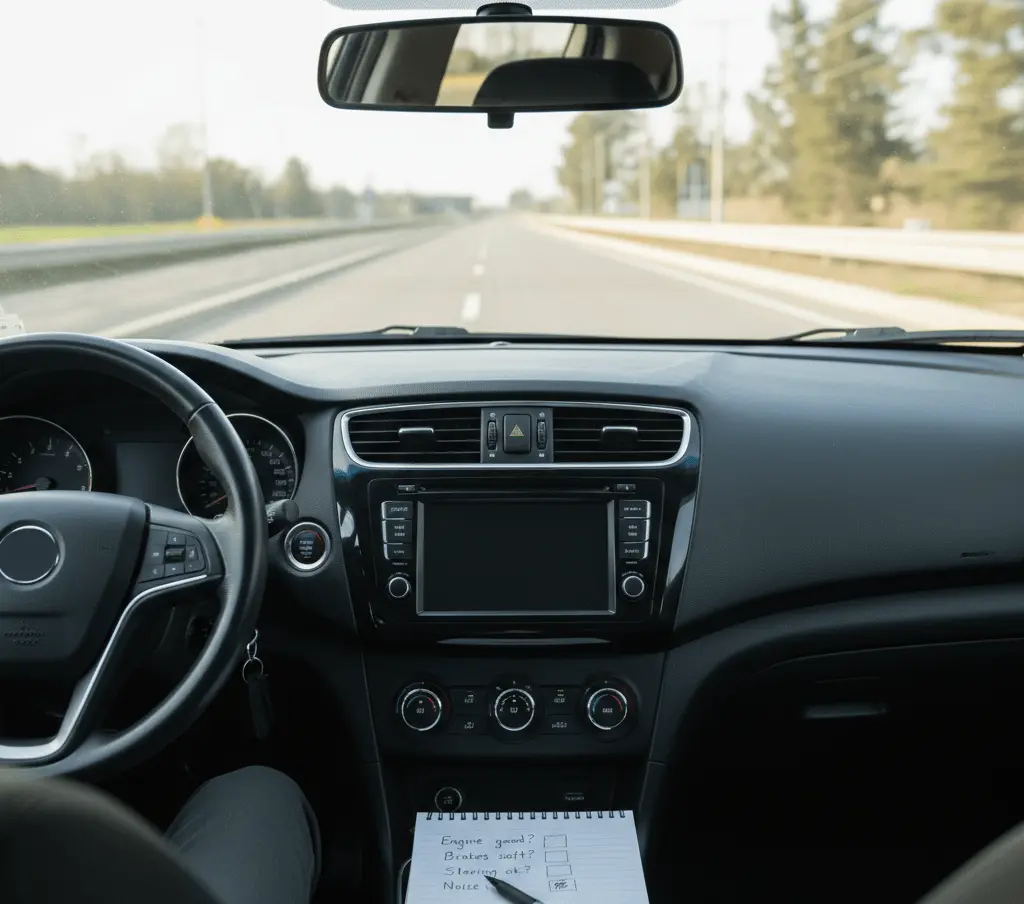
Radio off. Listen for:
- Humming with speed
- Clunks over bumps
- Brake squeaks
- Uneven wind noise
Braking checks
- Light braking for vibration
- Firm braking for pulling
- Pedal feel
Steering and alignment clues
- Tracks straight
- Stable over bumps
- Clicking at full lock
Transmission behavior
Automatics:
- Delayed engagement
- Harsh shifts
- Rpm flare
Manuals: - Clutch slip
- Grinding
- Vibration in shifter
Temperature after the drive
- Idle for a few minutes
- Watch temp gauge
- Smell for coolant
- Check for drips
Test drive checklist table
| Area | What to test | Red flags |
|---|---|---|
| Start and idle | Cold start, idle quality | Long crank, rough idle, ticking |
| Brakes | Light and firm stops | Pulsation, pulling, soft pedal |
| Transmission | Smooth shifts | Shudder, hesitation, rpm flare |
| Steering | Straight tracking | Pull, clicking, clunks |
| Suspension | Bumps | Knocking, rattles, floaty feel |
| Cooling | Idle after drive | rising temp, coolant smell, drips |
Use a natural internal link to Satellite 6 with an anchor like test drive mistakes that cost buyers thousands.
Section 6. Closing the deal: negotiation, ppi, warranty, and paperwork
This final step is where good buyers lose money. Usually because they are tired. Treat it like a checklist.
Lock the deal around out-the-door
Ask for an itemized out-the-door quote. Watch for vague lines and duplicate charges.
Use a natural internal link to Satellite 3 with an anchor like hidden fees in used car deals.
Negotiate with facts
Leverage:
- Comparable listings
- Tire and brake life
- Missing keys
- Service record gaps
- Ppi findings
Keep the offer simple:
“I’m ready to buy today at $X out the door with no add-ons.”
Use a ppi as a filter
A ppi helps you avoid surprises and negotiate with proof. If a seller refuses it, treat it as a red flag.
Warranty without pressure
Compare:
- Coverage and exclusions
- Deductible
- Claim limits
- Repair network
- Cancellation policy
Use a natural internal link to Satellite 5 with an anchor like extended warranty scams.
Paperwork checklist
- Vin matches car and title
- Title is transferable
- Lien status resolved
- Bill of sale matches agreed numbers
- Promised items written down
- Taxes and registration steps are clear
Use a natural internal link to Satellite 4 with an anchor like title problems and ownership red flags.
Payment and handoff
- Avoid large cash deals
- Prefer bank-backed payment methods
- Keep copies of documents
- Confirm you receive both keys and any wheel lock key
Conclusion
A smart used car purchase is not one big decision. It is a chain of small decisions that either protect you or drain you later. Keep the same routine every time. Research first. Walkaround second. Interior and scan third. Mechanical basics next. Test drive with a plan. Close with itemized numbers and clean paperwork.
For immediate value, start with test drive mistakes that cost buyers thousands because it is the fastest way to catch expensive problems before you buy.
If you want, I can also format the internal link anchors as exact sentences for each section, using your exact satellite urls and preferred anchor text style.